What to Look For in a Jump Starter
Choose a jump starter for your vehicle’s 12V system and engine size first. Then compare connection protection, storage needs, charging upkeep and extras you’ll actually use.
On this page (11 sections)
- What should you look for in a jump starter?
- How do you match a jump starter to your vehicle?
- What do peak amps tell you?
- Which safety features should you compare?
- How important are size and weight?
- Which extras are worth paying attention to?
- How should you compare charging and storage?
- Which jump starter features suit different buyers?
- How do you choose between lithium and lead-acid?
- What should you check before using a jump starter?
- How do you choose the right jump starter?
Choose a jump starter that matches your vehicle’s 12V system and engine size. Then weigh connection protection, portability, charging upkeep and useful extras against how and where you’ll store it.
A larger peak-amp number alone does not settle the choice. The right fit depends on your vehicle and the features you can use confidently.
If you’re still deciding whether you need one, start with what a jump starter is and whether you need one. This guide compares the buying details that matter and four examples with different strengths.
What should you look for in a jump starter?
Check vehicle compatibility first, then compare safety features and the package’s size and extras. A starter that does not suit your vehicle is a poor fit, no matter how many added functions it has.
Before shopping, note your vehicle’s voltage, engine type and engine size. Compare those details with the starter’s stated guidance, and ask the vehicle or starter maker if you can’t confirm a match.
| Buying factor | What to check | Why it matters |
|---|---|---|
| Vehicle fit | Voltage, fuel type and engine-size guidance | Confirms the starter is intended for your vehicle |
| Connection protection | Spark-proof, reverse-polarity or other protections | Can help reduce connection mistakes |
| Clamps and cables | Clamp design and any reach guidance | Affects how you connect to the battery or an approved grounding point |
| Size and weight | Dimensions and weight | Helps you plan where to store and handle it |
| Charging and upkeep | Recharge time and care interval | Helps you keep it ready |
| Extra functions | Light, USB power, air inflator or inverter | Adds value when those functions suit your plans |
The details work together. For example, a compact unit can be easier to keep in a glovebox, while a larger power station may better suit someone who also wants an inflator and AC power.
How do you match a jump starter to your vehicle?
Match the starter to the vehicle’s voltage and the maker’s engine guidance. Compare the exact engine type and size, not just the word “car” or “truck.”
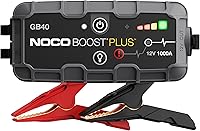
The four products here are described for 12V vehicles, but their engine guidance differs. NOCO describes the GB40 for engines up to 6.0L gas and 3.0L diesel; Gooloo describes the GP4000 for gas and diesel engines up to 10.0L.
Hulkman lists up to 8.5L gas and 6.0L diesel for the Alpha85, while DeWalt describes the DXAEPS14 for most 4-, 6- and 8-cylinder cars and trucks.
Those descriptions are not interchangeable. Check your vehicle’s manual for engine details, and confirm compatibility if the stated guidance leaves a question.
If you’re shopping for a larger engine, compare options in our guide to jump starters for V8 trucks and SUVs. For trucks, our pickup truck jump starter guide covers that use case.
What do peak amps tell you?
Peak amps are one comparison point, but they don’t tell the whole story. The engine guidance and intended vehicle fit are more useful starting points for choosing a unit.
The examples in this guide range from 1,000 A for the NOCO GB40 to 4,000 A for the Gooloo GP4000. That difference alone does not mean the higher number is always the better match for your vehicle or storage needs.
Read peak amps vs cranking amps for a closer explanation of the terms. Then use the manufacturer’s vehicle guidance to narrow your options.
Which safety features should you compare?
Look for clear connection guidance and protections that address common mistakes. The names and feature sets vary by model, so read the instructions before you need to use the starter.
The NOCO GB40 lists spark-proof and reverse-polarity protection. Gooloo describes 10 types of protection and smart jumper cables, while Hulkman describes 10 safety layers, including spark-proof and reverse-polarity protection.
DeWalt says its reverse-polarity protection warns when clamps are connected incorrectly.
Protection features can help, but they don’t replace careful setup. Follow the jump starter’s instructions, connect the clamps firmly to the correct points and heed any status indicators or warnings.
For the connection sequence, see how to use a car jump starter step by step. If the engine doesn’t start, the guide to how long to leave a jump starter connected covers a related question.
How important are size and weight?
Size and weight matter if you’ll keep the starter in a glovebox or carry it often. Check both dimensions and weight against your actual storage space.
The NOCO GB40 weighs 2.4 lb, and Gooloo lists the GP4000 at 3.9 lb. Hulkman lists the Alpha85 at 4.5 lb.
DeWalt’s DXAEPS14 is a larger power station at 17.3 lb, so it may make more sense in a trunk or garage than in a small glovebox.
Measure the space where you plan to keep the unit, including room for its clamps and cables. A case can help keep accessories together, but it also takes up space.
For a small storage area, compare the options in our portable jump starters for the glovebox guide. If you want a broader comparison before narrowing down by size, see car jump starters: what to know before you buy.
Which extras are worth paying attention to?
Extras help when they solve a separate need you already have. A flashlight, USB ports or air inflator can make one device useful in more situations, but each adds little if you won’t use it.
The four examples show different feature mixes:
- NOCO Boost GB40: a 100-lumen flashlight with seven modes and a power bank for compatible devices.
- Gooloo GP4000: a flashlight, two USB outputs and a USB-C port.
- Hulkman Alpha85: a display, flashlight and several outputs, including USB-A, USB-C and 15V DC.
- DeWalt DXAEPS14: a digital 120 PSI air inflator, 500W AC inverter, USB ports, LCD display and LED area light.
If you already carry a tire inflator, a combo unit may not add much. If you want a single package for jump starting and tire inflation, compare the options in our jump starter and air compressor combos guide.
Is a built-in light useful?
A built-in light can help you see connection points in low light. Compare its modes and placement with how you expect to use it.
The GB40 offers seven modes, including SOS and strobe. The GP4000 lists a built-in flashlight, while the Alpha85 has five light modes; DeWalt describes an LED area light.
Do USB ports and power outlets matter?
USB or AC power matters if you want to charge compatible devices away from a wall outlet. Check which ports and outputs the unit has, and whether they match your devices.
The DeWalt combines USB-A and USB-C ports with a 500W AC inverter. The other three examples list USB charging outputs, with the Alpha85 also offering a 15V DC output.
How should you compare charging and storage?
Choose a model whose charging routine fits your habits, and store it according to its instructions. A jump starter that has lost charge may not be ready when you need it.
NOCO says the GB40 recharges in 3 hours. Hulkman says the Alpha85 reaches 80% in 1 hour and a full charge in 90 minutes; it recommends recharging at least every 3 months.
Gooloo recommends charging the GP4000 every 2 to 3 months after extended idle periods.
Those intervals are model-specific. Keep the instructions with the device, check its charge status periodically and follow its storage temperature guidance.
Which jump starter features suit different buyers?
Pick the product whose vehicle guidance, size and extra functions match your priorities. These examples are not a ranked roundup; they show different combinations of features.
NOCO Boost GB40: compact storage and a flashlight
The NOCO Boost GB40 pairs 1,000 A peak power with a stated fit for up to 6.0L gas and 3.0L diesel engines. Its 2.4 lb weight and compact design make it a candidate for buyers who want a starter for a smaller storage space.
NOCO says it can provide up to 20 starts per charge. It includes heavy-duty clamps, a USB-C charging cable and a microfiber storage bag.
Consider it if you want a compact kit and its engine guidance fits your vehicle. Compare the full details in our guide to the best NOCO jump starters.
Gooloo GP4000: higher stated engine range
The Gooloo GP4000 is described for gas and diesel engines up to 10.0L. Its 4,000 A peak rating, protection features and smart clamps may suit drivers who want a higher stated engine range in a portable package.
Gooloo says a full charge can provide over 60 starts for most vehicles. The package includes an EVA storage case, a cigarette lighter socket adapter and a USB-to-Type-C cable; a wall charger is not included.
Consider it if its stated engine range matches your vehicle and you want the listed accessories. See more choices in our Gooloo jump starter guide.
Hulkman Alpha85: display and fast recharging
The Hulkman Alpha85 has a 3.3-inch display for status, battery level and possible errors. Hulkman describes it for engines up to 8.5L gas and 6.0L diesel, and says it can provide up to 60 jump starts per charge.
Hulkman says the Alpha85 charges from 0% to 80% in 1 hour and reaches full charge in 90 minutes. Its listed outputs include USB-A, USB-C and 15V DC; the package includes a 65W wall charger, a Type-C cable and a cigarette lighter socket adapter.
Consider it if a status display and faster recharge are priorities. Read the Hulkman Alpha85’s full details on Amazon before choosing.
DeWalt DXAEPS14: air inflator and AC power
The DeWalt DXAEPS14 combines jump-starting with a 120 PSI digital air inflator and a 500W AC inverter. DeWalt describes it for most 4-, 6- and 8-cylinder cars and trucks with compatible 12V WET, GEL and AGM lead-acid batteries.
Its display shows battery status, voltage, air pressure, connection warnings and USB status. The inflator can shut off automatically at the pressure you set, and it has a 10-minute auto shutoff feature.
Consider it if you want tire inflation and AC power alongside jump-starting. Its size and weight make it a different storage choice from the lighter lithium examples.
How do you choose between lithium and lead-acid?
Choose based on the full package and your storage plans, not battery chemistry alone. The listed lithium examples are lighter, while the DeWalt lead-acid unit combines jump-starting with an inflator and AC inverter.
The NOCO GB40, Gooloo GP4000 and Hulkman Alpha85 use lithium batteries. The DeWalt DXAEPS14 uses a sealed lead-acid battery and weighs 17.3 lb.
Compare each unit’s vehicle guidance, weight, charging needs and included functions. Our lithium vs lead-acid jump starters guide explains the trade-offs in more detail.
What should you check before using a jump starter?
Read the instructions and check charge level, vehicle compatibility and connection points before you need a jump. Keep the clamps clean and follow the device’s status indicators.
A simple pre-use check can help you avoid confusion in a roadside situation:
- Confirm that the starter is intended for your vehicle’s voltage and engine.
- Check that it has enough charge.
- Review the correct battery terminals or approved grounding point for your vehicle.
- Inspect the clamps and cables for visible damage.
- Follow the starter’s connection and disconnection sequence.
For a complete walkthrough, follow our step-by-step jump starter instructions. If your battery may be completely dead, see whether a jump starter can start a completely dead battery.
How do you choose the right jump starter?
Choose by vehicle fit first, then protection and practical features. A compact unit suits buyers who prioritize easy storage, while a larger power station can make sense when its inflator or AC output will get regular use.
Confirm the engine guidance against your vehicle, decide where you’ll store the unit, and choose extras that match your plans. For a broader shortlist, explore the site’s top jump starter picks.
Frequently asked questions
What should I look for in a jump starter?
Start with the voltage and engine-size guidance for your vehicle, then compare safety protections, clamp setup, charging needs and storage space. Consider extras such as a flashlight, USB power or an air inflator only if you expect to use them.
Keep the unit charged according to its instructions.
How many amps should a jump starter have?
There is no single amp number that fits every vehicle. Check the starter’s engine-size guidance and compare it with your vehicle and battery; peak amps alone do not tell you how it will perform in every situation.
Our guide to peak amps vs cranking amps explains the terms.
Are lithium jump starters better than lead-acid models?
Lithium models are often smaller and lighter, while lead-acid power stations can offer additional features in a larger package. Compare the complete unit, including weight, charging, storage and accessories, rather than choosing by battery chemistry alone.
Your vehicle’s compatibility and intended use matter most.
How often should I recharge a jump starter?
Follow the care instructions for your specific model. For example, Gooloo recommends charging the GP4000 every 2 to 3 months after extended idle periods, and Hulkman recommends charging the Alpha85 at least every 3 months.
Check charge status periodically so the unit is ready when needed.
Can I use a jump starter on any car?
No. Check that the jump starter is intended for your vehicle’s voltage and engine size, and follow its connection instructions.
The four examples here are described for 12V vehicles, but their stated engine guidance differs.
If your vehicle falls outside that guidance, ask the vehicle or starter maker before connecting it.