Can a Jump Starter Start a Completely Dead Battery?
A jump starter may start a car with a discharged battery if the battery can still accept power, the connections are sound, and the device suits the vehicle. A damaged or failed battery may need testing or replacement.
On this page (8 sections)
- Can a jump starter start a completely dead battery?
- What does “completely dead” mean for a car battery?
- When should you not try to jump the battery?
- What should you check before using a jump starter?
- What should you do if the jump doesn't work?
- Can a jump starter fix a battery that keeps dying?
- What should you do after the engine starts?
- When should you call for roadside help?
A jump starter may start a car with a discharged battery if the battery can still accept power, the connections are sound, and the device suits the vehicle. A damaged battery or a fault elsewhere in the starting system can prevent a jump from working.
“Completely dead” can mean different things: the battery may be drained, worn out, damaged, or unable to hold a charge. A jump can provide temporary power, but it can't repair a battery that has failed.
Can a jump starter start a completely dead battery?
It can start some discharged batteries, but it cannot revive every battery that appears dead. The key question is whether the battery and vehicle can accept and use the power.
If the battery simply ran down after lights were left on, a suitable jump starter may get the engine running. If the battery is cracked, swollen, leaking, or has an internal failure, don't try to jump it.
A jump that works also doesn't prove the battery is healthy. If it goes flat again, have the battery and charging system checked.
What does “completely dead” mean for a car battery?
A battery that won't start the engine may still have some charge left. A weak or discharged battery can behave differently from one with physical damage or an internal fault.
Common signs of a low charge include dim headlights, slow cranking, or a clicking sound when you turn the key. No lights at all can also point to loose or corroded connections, a failed battery, or another electrical issue.
Don't rely on symptoms alone to diagnose the cause. Check the vehicle manual, inspect only what you can reach safely, and get help if you aren't sure.
Can a jump starter help a battery that is deeply discharged?
A jump starter may help if the battery can still accept power and the device can supply enough for the vehicle. Check the device instructions for any limits or special steps when the battery is deeply discharged.
The NOCO Boost GBX45 can gain enough power for a jump start in 5 minutes, even from a completely depleted jump starter battery. This describes the device's charge, not a guarantee that it can start a car with a failed battery.
If the vehicle battery won't accept a jump, repeated attempts won't fix it. Stop and arrange battery testing or roadside help.
When should you not try to jump the battery?
Don't connect a jump starter to a battery that is cracked, swollen, leaking, or unusually hot. These signs can indicate damage, and trying to jump the battery can create additional risk.
Also stop if the clamps, cables, or battery terminals are damaged. Read the vehicle and jump starter manuals before connecting anything, and don't guess about terminal locations or connection order.
If the battery looks intact but you can't identify the terminals or the right connection steps, ask for roadside assistance. A safe connection matters more than getting a quick start.
What should you check before using a jump starter?
Check the battery's condition, the jump starter's charge, and its fit for your vehicle. Read both manuals so you know the required connection steps and any limits.
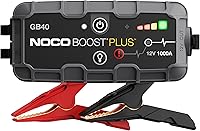
Confirm that the jump starter is intended for the vehicle's battery voltage and engine type. NOCO rates the GB40 for engines up to 6.0L gas and 3.0L diesel, and the GB50 for engines up to 7.0L gas and 4.5L diesel.
The NOCO Boost GB40 has spark-proof and reverse-polarity protection. These features don't replace careful setup, so follow its instructions every time.
For the basic connection sequence, see how to use a car jump starter step by step. If you need to choose a device first, what to know about car jump starters covers common features and fit.
What should you do if the jump doesn't work?
Check the connections once and follow the device instructions; stop if the engine still won't start. A failed jump can mean the battery is too damaged or discharged, the clamps aren't making good contact, or another part has failed.
Don't keep making repeated attempts without checking the manual. If the starter's indicators show an error, use its troubleshooting steps rather than guessing.
If the jump starter itself won't turn on or charge, see what to check when a jump starter won't charge or turn on. For recommended waiting and connection time, read how long to leave a jump starter connected.
Can a jump starter fix a battery that keeps dying?
No, a jump starter only helps start the vehicle; it doesn't fix the reason the battery lost charge. A battery that repeatedly goes flat needs diagnosis.
Possible causes include an aging or damaged battery, a charging-system problem, a loose connection, or an electrical draw while the vehicle is off. A mechanic or roadside service can test the battery and charging system.
Cold temperatures can also make starting harder. If the problem happens in winter, what to try first when a car won't start in cold weather covers other checks.
Is the NOCO Boost GB50 suitable for a larger engine?
The NOCO Boost GB50 is rated for engines up to 7.0L gas or 4.5L diesel. Confirm your engine size and follow the product and vehicle instructions.
The GB50 has spark-proof and reverse-polarity protection. Those features don't make it suitable for a damaged battery or guarantee a start.
What should you do after the engine starts?
Follow your vehicle manual's instructions after a jump, then have a repeatedly failing battery checked. A successful jump is a way to get moving, not a repair.
Disconnect the jump starter in the order its instructions specify. If warning lights appear, the engine stalls, or it won't restart, arrange professional help instead of relying on another jump.
For a one-time drained battery, check that lights and accessories are off before leaving the vehicle. If it happens again, testing can help determine whether the battery or another part needs attention.
When should you call for roadside help?
Call for help if the battery is damaged, you can't connect the clamps safely, or the vehicle still won't start after following the instructions. A professional can test the battery and check for other starting faults.
Use a jump starter for a discharged battery that appears intact and suits the device. If it fails to start or the battery shows damage, stop and get the battery tested; a jump starter can't restore a failed battery.
Frequently asked questions
Can a jump starter start a completely dead battery?
Sometimes. A portable jump starter may start a car if its battery is discharged but still able to accept power and the connections are sound.
A damaged battery, failed cell, bad connection, or another vehicle fault can prevent a start.
Stop if the battery is swollen, cracked, leaking, or unusually hot.
Should I charge a jump starter before using it?
Yes. Check its charge level and recharge it according to its instructions before relying on it.
A jump starter with too little charge may not supply enough power, especially when the car is difficult to start.
Keep the clamps and cable in good condition, and follow the instructions for your model.
How long should I leave a jump starter connected?
Follow the jump starter's instructions for connection time and starting attempts. Some models provide power immediately, while others may need a brief wait.
Don't leave clamps connected longer than instructed, and disconnect them in the order the manual specifies after the engine starts or an attempt fails.
What if the car still won't start after a jump?
Check that the clamps are on the correct battery terminals and make firm contact, then follow the jump starter's instructions for another attempt. If the starter clicks, the lights stay dim, or the engine still won't turn over, stop and seek help.
The fault may involve the battery, starter, alternator, or wiring.