Car Jump Starters: What to Know Before You Buy
A car jump starter can help you restart a 12V vehicle without another car. Match the unit’s engine guidance to your vehicle, check its connection features and charging needs, and keep it charged and accessible.
On this page (9 sections)
- What should you check before buying a car jump starter?
- Which car jump starter fits your needs?
- What do peak amps and engine size tell you?
- What extra features are worth carrying?
- Where should you store and charge a jump starter?
- How do you set up a car jump starter before you need it?
- How do you use a car jump starter safely?
- What common jump starter mistakes should you avoid?
- Which car jump starter should you choose?
A car jump starter can help you try to restart a 12V vehicle without another car, if the unit suits the engine and you connect it as directed. Before buying, check the stated gas or diesel engine range, connection protections, charging method and storage needs.
A compact model may suit a passenger car and glovebox. A larger unit may offer broader engine guidance or extra power outlets, but size, weight and the functions you will use matter too.
This guide compares four options for different needs. For a quick primer on how these devices work, start with what a jump starter is and whether you need one.
What should you check before buying a car jump starter?
Start with vehicle fit, safe connections and maintenance. Those factors help you decide if a unit suits your vehicle and will be ready when you need it.
| Check | What to compare |
|---|---|
| Vehicle fit | 12V compatibility and the stated gas or diesel engine range |
| Connection features | Spark-proof, reverse-polarity or other clamp protections |
| Charging | Included cable or adapter, recharge time and storage interval |
| Portability | Weight, size and where you plan to keep it |
| Extra functions | USB power, light, air inflator or AC inverter, if useful to you |
Peak amps appear prominently in product names, but the number alone does not determine fit. Compare engine guidance and instructions for the exact model, then choose features around how you plan to carry and use it.
Think about the vehicle you need to start, where you can store the unit, and how often you are willing to check and recharge it. A small unit that stays in the glovebox may be easier to access than a heavy power station, while a larger device may make sense if you also want an inflator or AC outlet.
A jump starter also needs upkeep. Check its charge before relying on it, and follow the manual for charging, storage temperature and recharge intervals.
How do you match a car jump starter to your engine?
Match the stated engine range for gas or diesel to your vehicle, then confirm the unit is intended for your vehicle’s voltage. A rating for one fuel type or engine size does not automatically apply to another.
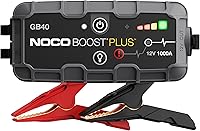
For example, NOCO rates the Boost GB40 for engines up to 6.0L gas and 3.0L diesel. Hulkman describes the Alpha85 for up to 8.5L gas and 6.0L diesel engines.
Gooloo describes the GT4000S for 12V engines up to 12.0L gas and 10.0L diesel. DeWalt describes the DXAEPS14 for most 4-, 6- and 8-cylinder cars and trucks with 12V WET, GEL and AGM lead-acid batteries.
If you drive a truck or SUV with a larger engine, compare models made for that use in our jump starters for V8 engines guide. Your vehicle manual and jump starter manual should guide the final choice.
Which safety features matter on a jump starter?
Look for clear connection instructions and protection against common clamp mistakes. Spark-proof and reverse-polarity protection can help reduce connection errors, but they do not replace careful setup.
The NOCO Boost GB40 has spark-proof and reverse-polarity protection. Hulkman lists a 10-layer protection system, including spark-proof and reverse-polarity protection, and the DeWalt DXAEPS14 warns when the clamps are connected incorrectly.
Check the instructions before an emergency. Do not use cables or clamps that are visibly damaged, and stop if the unit displays an error you cannot resolve from its manual.
Features that warn about a problem can make setup clearer, especially if you have little experience with booster cables. Still, you need to identify the correct connection points and follow the steps in the vehicle and jump starter manuals.
Which car jump starter fits your needs?
The right model depends on your vehicle, storage space and need for extra functions. These options cover a compact jump starter, broader engine guidance, fast charging and a combined power station with an inflator.
NOCO Boost GB40 for a compact kit
The NOCO Boost GB40 suits drivers who want a compact lithium jump starter for a glovebox or emergency kit. It weighs 2.4 lb and is rated for engines up to 6.0L gas and 3.0L diesel.
The GB40 has a 100-lumen light with seven modes, including SOS and strobe. Its power bank can charge phones and tablets, and NOCO says it recharges in 3 hours.
Its stated engine range is narrower than the Hulkman Alpha85 and Gooloo GT4000S. Check that range against your vehicle before choosing it.
Choose this model if low weight and simple storage matter more than a display or a broad set of power outputs. Skip it if your vehicle falls outside its stated engine range or you specifically want an inflator or AC inverter built into the same unit.
Hulkman Alpha85 for a screen and broader engine range
The Hulkman Alpha85 suits drivers who value a display and broader stated engine coverage. Hulkman gives it a 3.3-inch screen and rates it for engines up to 8.5L gas and 6.0L diesel.
The Alpha85 weighs 4.5 lb. It also has a built-in light with five modes, USB-A and USB-C outputs, and a 15V DC output.
Hulkman says it can charge from empty to 80% in 1 hour and reach a full charge in 90 minutes with its 65W charging system. Its guidance says to recharge at least every 3 months and avoid extreme temperatures during charging or storage.
Choose it if you want a screen that shows status and errors, plus a larger stated engine range than the compact NOCO. Skip it if your priority is the lightest possible glovebox kit or you do not need the added charging outputs.
Gooloo GT4000S for fast charging and extra ports
The Gooloo GT4000S suits drivers looking for fast charging and several emergency power options. Gooloo describes it for 12V engines up to 12.0L gas and 10.0L diesel, and says a full charge can provide up to 60 starts.
The GT4000S has a 3.2-inch screen, a 400-lumen light with three modes and a 15V/10A DC output for compatible devices. Gooloo says the jump starter can fully charge in 1.2 hours with its fast-charging setup.
Its storage guidance says to recharge at least every 3 months and keep it within the stated operating, storage and charging temperature ranges. The unit weighs 4.5 lb, so plan a storage spot before buying.
Choose the GT4000S if a fast recharge, multiple ports and wider stated engine coverage matter to you. Skip it if you want a very small unit or do not expect to use its extra power functions; those features add little value when you only need a basic kit.
DeWalt DXAEPS14 for an inflator and AC power
The DeWalt DXAEPS14 suits drivers who want an air inflator and AC inverter with jump-starting capability. It combines 2000 peak amps with a 120 PSI digital inflator and a 500W AC power inverter.
DeWalt describes the unit for most 4-, 6- and 8-cylinder cars and trucks with 12V WET, GEL and AGM lead-acid batteries. It also has USB-A and USB-C ports, a display and an LED area light.
At 17.3 lb, it is much heavier than the lithium models above. Choose it if the inflator and inverter are useful enough to justify keeping a larger unit in your vehicle.
The inflator has a digital pressure setting and automatic shutoff, and its 10-minute timer helps avoid overheating if it is left on unintentionally. Those controls suit drivers who expect to top up tires or inflate other items listed for the unit, such as bike and scooter tires or sports equipment.
Skip it if you want a unit that fits easily in a small glovebox or can be carried with little effort. Its weight and larger size make storage a real part of the decision.
What do peak amps and engine size tell you?
Peak amps are one part of a jump starter’s fit, not a stand-alone buying rule. Compare the stated engine range, vehicle voltage and connection instructions alongside the amp figure.
The product titles show peak figures of 1000A for the NOCO Boost GB40, 2000A for the Hulkman Alpha85 and DeWalt DXAEPS14, and 4000A for the Gooloo GT4000S. The Gooloo specification also shows a 1000A amperage figure, so compare the brand’s engine guidance and instructions instead of relying on a single number.
A higher peak figure does not mean every vehicle can use that unit or that it is the right choice for your storage needs. For a closer explanation, read peak amps vs cranking amps.
Engine displacement is useful because it lets you compare your vehicle with a maker’s stated gas or diesel range. It does not tell you to ignore the vehicle’s own instructions, battery condition or connection procedure.
Use the amp figure as one comparison point, then verify the engine fit and the unit’s intended vehicle voltage. If the guidance does not clearly cover your vehicle, choose a model with an applicable range or ask the manufacturer before relying on it.
What extra features are worth carrying?
Extra features matter when you have a clear use for them. A light or USB port takes little planning, while an inflator or AC inverter may affect how much room and weight you are willing to keep in the vehicle.
- Light: useful for seeing clamps and cables in low light. The GB40 has seven modes, while the Gooloo GT4000S has three.
- USB charging: useful for phones and other compatible devices. Check which ports and charging speeds you need.
- Air inflator: the DeWalt DXAEPS14 digital inflator is rated to 120 PSI and has an automatic shutoff.
- AC power: the DeWalt DXAEPS14 includes a 500W inverter for compatible small electronics.
- DC output: the Hulkman Alpha85 and Gooloo GT4000S include DC outputs for compatible devices.
A flashlight can help you see the clamps and battery area, but it does not make a dark roadside a safe place to work. Position the vehicle away from traffic and use hazard lights or other visibility equipment as appropriate.
USB charging can be useful during a delay, but check which port supports the device you plan to charge and whether you need a cable. For laptop charging, Gooloo describes USB-C output up to 100W on the GT4000S, while the Alpha85 has USB-C PD18W output.
Choose based on the equipment you would actually use. If you only need emergency starting power, a smaller, lighter unit may be easier to keep accessible.
Where should you store and charge a jump starter?
Store the unit where you can reach it and within its temperature guidance. Avoid burying it under cargo, and check its manual for charging and storage conditions.
The NOCO Boost GB40 weighs 2.4 lb, while the Hulkman Alpha85 weighs 4.5 lb. The DeWalt DXAEPS14 weighs 17.3 lb, so it may suit a trunk or truck bed better than a small glovebox.
Charging intervals differ by model. Hulkman and Gooloo advise recharging at least every 3 months, and NOCO says the GB40 recharges in 3 hours.
Make a simple maintenance habit: inspect the charge before a long drive, after using the jump starter, and before storing the vehicle for a season. Follow the manual’s specific schedule, since storage guidance varies by model.
Keep the unit and its cables together so they are ready when needed. A storage bag can help keep the clamps from tangling with other items, while a dedicated place in the trunk makes it easier to find during a roadside problem.
For the GT4000S, Gooloo gives operating and storage temperatures of -4°F to 140°F, and a charging range of 14°F to 113°F. Hulkman says to avoid extreme temperatures while charging or storing the Alpha85.
Do not leave a lithium jump starter in a location that exceeds its temperature guidance. Cold conditions can affect starting and battery equipment, so see what to try when your car won’t start in cold weather and what belongs in a winter car emergency kit.
How do you set up a car jump starter before you need it?
Set up your kit in advance by reading the manual, charging the unit and learning where the clamps connect. These steps reduce guesswork when a battery problem happens.
First, fully charge the unit if its instructions call for that before first use. The Gooloo GT4000S specifically recommends a full charge before first use, and Hulkman and Gooloo both advise recharge checks at least every 3 months during long storage.
Next, keep the manual with the unit or save an accessible copy. Find the directions for connecting the clamps, reading warnings, starting the vehicle and removing the clamps.
The correct sequence can vary by model and vehicle.
If you have never used a booster, review the procedure when you are not under pressure. Locate the vehicle’s recommended jump points in its manual, and make sure you know how the jump starter indicates a correct connection.
Pack the supplied charging cable or adapter if you plan to recharge away from home. The Alpha85 includes a 65W wall charger, while the GT4000S includes a 100W car charger; the GB40 includes a USB-C charging cable.
How do you use a car jump starter safely?
Use a jump starter by following its manual’s clamp order, connection steps and start instructions. The exact steps vary, so do not guess based on another model’s directions.
Before connecting, park safely, turn off the vehicle and inspect the battery, cables and clamps. Connect only to the points the vehicle and jump starter manuals specify, and stop if the unit warns of a connection error.
Once the vehicle starts, remove the clamps in the order the manual gives. Our step-by-step car jump starter guide covers the process in more detail.
If the unit does not recognize a connection or shows an error, pause and consult its instructions. Do not repeatedly reposition clamps while the system is powered or try a boost feature without following the model’s stated procedure.
Some models describe support for completely dead batteries or include a boost mode. That does not mean every failed or damaged battery can be restarted, and a jump starter cannot repair a battery that needs replacement.
A successful start also does not prove the battery or charging system is healthy. If the vehicle stalls again or will not stay running, arrange a proper diagnosis instead of relying on repeated jump attempts.
What common jump starter mistakes should you avoid?
Avoid choosing by peak amps alone, ignoring storage care and improvising the connection sequence. Most preventable problems begin with a mismatch or an assumption about how the unit works.
- Buying without checking engine fit: compare the exact gas or diesel range with your vehicle.
- Treating every 12V vehicle as a match: voltage alone does not confirm engine compatibility.
- Assuming a protection feature makes setup foolproof: warnings and safeguards do not replace the manual.
- Leaving the unit discharged: check charge before travel and follow the recommended maintenance interval.
- Storing it in extreme temperatures: follow the unit’s guidance, especially for charging.
- Forgetting the unit’s size and weight: choose a storage space you can access and use.
- Trying to repair a damaged battery with a booster: a jump starter supplies starting assistance; it does not repair battery damage.
- Using extra power ports without checking compatibility: confirm the required output and device input before connecting equipment.
Another common mistake is leaving the jump starter buried beneath luggage. If you cannot reach the unit and clamps safely, its compact size or extra features do not help much in an emergency.
Do not choose an inflator or inverter just because it sounds useful. Consider the devices you already carry and whether you need to inflate tires or power small electronics; otherwise, a simpler starter may be the better fit.
Which car jump starter should you choose?
Choose the model that fits your engine range and storage habits, then use extra functions as a tie-breaker. The NOCO Boost GB40 is a compact option for engines within its stated range, while the Hulkman Alpha85 and Gooloo GT4000S cover larger stated engine sizes.
Pick the NOCO if you want a lighter kit for a glovebox and your engine fits its guidance. Choose the Hulkman if a clear screen, fast charging and a moderate size matter to you.
Pick the Gooloo if you want fast charging, several ports and broader stated engine coverage. Choose the DeWalt if you’ll use its inflator and inverter enough to justify a much heavier unit.
Skip any model whose engine guidance does not cover your vehicle, or whose size and maintenance needs do not fit how you travel. For more options by size and use, compare our best portable jump starters for the glovebox and best-rated jump starters for cars.
A car jump starter is a useful emergency tool when it is compatible, charged and easy to reach. Check those three points before you buy, keep its manual with the kit, and follow the model’s connection instructions when you need it.
Frequently asked questions
What size car jump starter do I need?
Choose a jump starter whose stated engine range covers your vehicle, and check whether the guidance names gas or diesel engines. The NOCO Boost GB40 is rated for up to 6.0L gas and 3.0L diesel, while the Hulkman Alpha85 covers up to 8.5L gas and 6.0L diesel.
Follow your vehicle and jump starter manuals.
Can a portable jump starter start a completely dead battery?
Some models describe support for completely dead batteries or include a boost mode, but a jump starter cannot repair a failed battery. Follow the unit's manual for any boost procedure, and stop if the clamps, cables or battery look damaged.
See our guide to jump starting a completely dead battery.
How long should you leave a jump starter connected?
Follow the jump starter's manual for connection and start attempts; there is no safe universal wait time for every model and vehicle. Remove the clamps in the order the manual gives once the vehicle starts.
Our guide explains how long to leave a jump starter connected.
How often should you recharge a car jump starter?
Check the manual for storage and recharge intervals, then inspect the charge before a trip or seasonal storage. Hulkman Alpha85 and Gooloo GT4000S guidance says to recharge at least every 3 months; avoid charging or storing either in extreme temperatures.
Can you use a jump starter on any car?
No. Check that the jump starter matches your vehicle's voltage and the engine range stated for the unit.
Then follow both manuals.
The products here are described for 12V vehicles, but their engine guidance differs.
For a step-by-step connection guide, read how to use a car jump starter.