Peak Amps vs Cranking Amps on a Jump Starter
Peak amps are a brief maximum rating; cranking amps measure output under a defined starting test. For peak amps vs cranking amps, compare like-for-like ratings, then choose by your vehicle's voltage, engine guidance and intended use.
On this page (8 sections)
- What is the difference between peak amps and cranking amps?
- Can you compare peak amps with CCA?
- Which specs matter more than the biggest amp number?
- Which jump starters show how these ratings work?
- Does a bigger engine always need more peak amps?
- How should you set up and care for a jump starter?
- What mistakes make amp comparisons less useful?
- How do you choose between peak amps and cranking amps?
Peak amps vs cranking amps on a jump starter comes down to a brief maximum rating versus current measured during a defined starting test. The figures aren't interchangeable, so choose by engine guidance, rating details and safe-use instructions rather than the biggest peak number.
A peak rating can help you compare models within a maker's range, but it doesn't tell you how long that output lasts or what test conditions were used. A cranking rating is more useful for comparisons only when the test method and conditions are clear and consistent.
For a larger vehicle, start with our guide to jump starters for V8 engines. For a broader look at features and fit, see what to look for in a jump starter.
What is the difference between peak amps and cranking amps?
Peak amps are a short-duration maximum; cranking amps describe output during a defined test. The rating names alone don't show whether two products were measured in the same way.
Peak amps may refer to the highest current a jump starter can deliver briefly. Cranking amps are tied to a test with stated conditions, such as voltage, temperature and duration.
Cold cranking amps, or CCA, are measured under a cold-temperature test. CCA is one kind of cranking rating, not another name for peak amps.
| Rating | What it describes | What to check |
|---|---|---|
| Peak amps | Brief maximum current claim | Test duration and method, if stated |
| Cranking amps | Current under a starting test | Standard, voltage, temperature and duration |
| Cold cranking amps (CCA) | Cranking output under a cold test | Applicable standard and conditions |
Use this table as a reading guide, not a conversion chart. There isn't a reliable universal formula for turning a peak-amp number into cranking amps.
Why do jump starters advertise peak amps?
Peak amps give shoppers a simple number to compare, but the number needs context. Treat it as one specification, not a promise that the unit will start every engine.
Start with the maker's stated engine range and the vehicle you own. A model may give separate limits for gas and diesel, so check the limit for your fuel type instead of assuming one applies to both.
The peak figure is most useful for screening products when other details also fit: compatible voltage, stated engine range, connection safeguards and charging needs. If you're shopping for a truck or SUV, read our heavy-duty jump starter guide.
Can you compare peak amps with CCA?
No, not directly. CCA is measured under a cold test, while a peak rating may describe a short burst under different or unstated conditions.
If a product publishes both ratings, look for the definitions and test conditions before comparing them. If it publishes only peak amps, don't estimate a CCA value from that figure.
This distinction matters when you shop for winter use, because cold conditions can make starting harder. Our guide to starting a car in cold weather covers other steps to consider before assuming the jump starter's amp rating is the problem.
Which specs matter more than the biggest amp number?
Start with vehicle compatibility and the maker's engine-size guidance. Then check the rating details, connection protections, charging options and care instructions that fit your needs.
Use this checklist to narrow the choice:
- Voltage: Match the jump starter to the vehicle's system. The examples in this guide are 12V units.
- Engine guidance: Check the stated gas and diesel limits separately.
- Rating type: Identify whether the figure is peak amps, cranking amps or CCA.
- Test details: Compare standards and conditions when they're published.
- Protection and use: Read about clamp safeguards and follow the user guide.
- Readiness: Keep the unit charged as instructed and check its status before a trip.
If your vehicle is a pickup, our jump starters for pickup trucks guide can help you compare models by vehicle use. For a wider checklist, the jump starter buying guide explains other features that affect fit.
Which jump starters show how these ratings work?
These 4 examples publish peak-amp ratings alongside engine-fit guidance. Their figures don't provide comparable cranking-amp or CCA values, so use them to compare stated fit and features rather than infer a different rating.
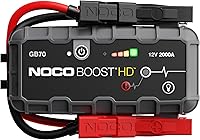
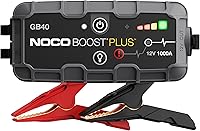
NOCO Boost GB40
The NOCO Boost GB40 suits drivers of smaller vehicles who want a compact emergency unit with a clearly stated engine range. It's specified for gas engines up to 6.0L and diesel engines up to 3.0L, and weighs 2.4 lb.
Its 1,000A peak rating isn't a cranking-amp figure. The GB40 also has spark-proof and reverse-polarity protection, a power bank, and a 100-lumen light with 7 modes, making it a practical choice if glovebox storage and basic emergency lighting matter.
Choose it if its engine guidance matches your vehicle and you value a smaller form. Skip it if you need a model with a higher stated engine range, such as for a diesel above 3.0L.
Gooloo GP4000
The Gooloo GP4000 fits drivers who want a higher stated engine range and multiple charging ports. It's specified for all gas engines and diesel engines up to 10.0L.
Its 4,000A peak rating doesn't guarantee a CCA value. The GP4000 also has a BOOST button for very low battery voltage and 10 types of protection.
It includes a flashlight, and Gooloo advises charging it every 2–3 months if it has been idle for an extended period.
Choose it if its engine guidance fits and you want a portable charger alongside jump-starting. Skip it if you need the GT6000's stated diesel range up to 12.0L or its 100W charging features.
Gooloo GT6000
The Gooloo GT6000 suits drivers who want broad engine guidance and fast charging in one unit. It's specified for all gas engines and diesel engines up to 12.0L.
The GT6000's peak rating doesn't tell you its cranking amps. Its other features include a display, 10 types of protection, a 27000mAh power bank, and a 400-lumen flashlight with 3 modes.
Gooloo says it can recharge from 0% to 100% in 1.4 hours with its included 100W car charger.
Choose it if the larger stated engine range or fast charging meets a real need. Skip it if your vehicle fits a smaller model and you won't use the additional charging features.
NOCO Boost GBX155
The NOCO Boost GBX155 suits drivers who need a stated fit for larger gas and diesel engines and want USB-C charging. It's specified for gas engines up to 10.0L and diesel engines up to 8.0L.
Its 4,250A peak rating is not a cranking-amp figure. NOCO describes spark-proof and reverse-polarity protection and 60W USB-C power delivery.
It also has a 500-lumen light with 7 modes and weighs 7 lb, so it's less suited to someone prioritizing a light glovebox carry.
Choose it if the engine guidance fits and you value its USB-C output. Skip it if you don't need those features or want a smaller, lighter emergency pack.
Does a bigger engine always need more peak amps?
Engine size is a useful screening factor, but the maker's stated fit guidance is the practical starting point. Fuel type, battery condition and temperature also affect whether a vehicle starts.
A diesel engine may have a different limit from a gas engine on the same jump starter. Check the specific limit for your engine instead of relying on a general rule about displacement or assuming a larger peak number settles the question.
A jump starter can't fix every no-start problem. A damaged battery, poor clamp contact or a separate vehicle fault may need attention; read whether a jump starter can start a completely dead battery.
How should you set up and care for a jump starter?
Read both the vehicle and jump starter instructions before connecting the clamps. Charge the unit as directed, inspect the cables and clamps, and use a compatible 12V starter.
Before a trip, check that the jump starter has enough charge and that its cables and clamps aren't damaged. Keep the manual with the unit or make sure you can find it when needed.
If the model has a status display or indicators, use them to confirm readiness rather than guessing from the amp rating.
At the vehicle, park safely and follow the connection order in the instructions. Attach the clamps firmly to clean terminals and watch for the device's status indication.
Don't guess at clamp placement or bypass a protection alert; correct the connection or consult the manual first.
After a start, disconnect in the order the instructions specify. Recharge and store the unit as directed.
Follow any model-specific upkeep guidance. For example, Gooloo advises charging the GP4000 every 2–3 months after an extended period of inactivity.
For step-by-step connection guidance, see how to use a car jump starter. That guide can help you prepare before an emergency, while your particular starter's instructions determine its controls and connection sequence.
What mistakes make amp comparisons less useful?
The biggest mistake is treating a peak figure as a substitute for a cranking or CCA rating. Other common errors include comparing unlike tests, overlooking the engine limit, and buying features you'll never use.
Avoid these shortcuts:
- Don't convert peak amps to CCA. There's no universal conversion that makes the figures equivalent.
- Don't compare numbers without test conditions. If the standards or conditions differ, the comparison may not be meaningful.
- Don't use one engine limit for every fuel type. Check the gas and diesel guidance separately.
- Don't assume a high rating fixes a weak battery. A jump starter is for starting assistance, not repair of a damaged battery or another vehicle fault.
- Don't ignore readiness. A suitable unit that's uncharged or has damaged clamps may not be ready when you need it.
- Don't keep trying without checking the cause. If the vehicle doesn't start, follow the troubleshooting steps instead of repeatedly attempting starts.
A high peak number can catch your eye, but compatibility, charge and correct connections determine whether a model is a sensible match for your situation.
How do you choose between peak amps and cranking amps?
Choose by compatible voltage, engine guidance and rating details, in that order. If a jump starter gives only peak amps, use its stated engine fit and instructions; don't treat the peak number as a cranking rating.
For a smaller car within the stated limits, the GB40 is the compact option here. For a diesel engine with a higher stated limit, compare the GP4000, GT6000 and GBX155 against your engine and the features you need.
The GT6000 has the broadest stated diesel range among these examples; the GBX155 offers USB-C output and a 7 lb form.
If two models both fit your engine, decide based on storage size, charging needs, protection features and how often you expect to use the unit. If the current ratings aren't defined under the same test conditions, don't rank the products by comparing their peak numbers alone.
For another look at models intended for larger vehicles, see our best heavy-duty jump starters guide. The useful takeaway about peak amps vs cranking amps is simple: compare like with like, then buy for your engine and use case.
{{related}}
Frequently asked questions
Are peak amps the same as cranking amps?
No. Peak amps describe a brief maximum output, while cranking amps describe current delivered during a specified test.
The test conditions matter, so compare cranking ratings only when the same standard, voltage and temperature are used.
A larger peak number by itself does not tell you how a starter will perform on your engine.
Are more peak amps always better?
Not by themselves. Peak output is one specification, but it does not show the full test method or guarantee a successful start.
Check that the jump starter is intended for your engine size and fuel type, follow the vehicle and starter instructions, and keep the clamps connected as directed.
What does CCA mean on a jump starter?
CCA means cold cranking amps, a rating measured under a cold-temperature test. It is different from a peak-amp figure, and the two numbers should not be treated as interchangeable.
Look for a clearly defined test standard before comparing CCA ratings between jump starters.
How many amps does my jump starter need?
Use the brand’s engine-size guidance as your first filter, then compare clearly defined current ratings if available. Gas and diesel engines can have different requirements, and cold conditions can make starting harder.
If a brand publishes only a peak number, don't convert it into a cranking-amp figure.
Can a jump starter with more peak amps damage my car?
A higher peak-amp rating alone does not mean a jump starter will force that current into your car; the vehicle draws current as needed during starting. Still, use a compatible 12V unit, connect it correctly and follow both manuals.
Stop if the cables, battery or connections appear damaged.