9 Best Heavy Duty Jump Starters (October 2026)
The best heavy duty jump starters include the NOCO Boost GBX155 for large diesel trucks, the NOCO Boost GBX75 for lighter truck kits, and the NOCO Boost GB150 for repeated starts.
On this page (9 sections)
- How we chose heavy duty jump starters
- Heavy duty jump starters for large vehicles
- How do you choose a heavy duty jump starter by engine and voltage?
- When does a heavy duty vehicle need a 24V jump starter?
- Should you choose lithium or lead-acid for heavy duty work?
- How much cable length should you look for?
- How should you set up and care for a jump starter?
- What mistakes should you avoid with a heavy duty jump starter?
- Which best heavy duty jump starter should you choose?
The best heavy duty jump starter for most large 12V engines is the NOCO Boost GBX155, rated for gas engines up to 10.0L and diesel engines up to 8.0L. For 24V equipment, consider the Clore JNC1224 or YESPER 12V/24V 6000A.
Choose by engine size and system voltage first. Then weigh portability, cable reach, charging time and the features you expect to use.
If you're choosing for a pickup, see our jump starters for pickup trucks. Our guide to jump starters for V8 engines can help narrow the options by engine type.
Our picks at a glance
-
1

-
2

-
3

How we chose heavy duty jump starters
The best heavy duty jump starter for a large vehicle must match its voltage and engine size before extra features matter. We compared the stated engine ranges, output, weight, cable reach, battery type and charging options.
Peak amps are only one part of the choice. Our guide to peak amps vs cranking amps explains why those figures describe different measures.
| Product | Best for | Peak amps | Engine fit | Voltage | Our score |
|---|---|---|---|---|---|
| NOCO Boost GBX155 | large diesel trucks | 4,250 A | Up to 10.0L gas, 8.0L diesel | 12V | 8.2 |
| NOCO Boost GBX75 | lighter truck kits | 2,500 A | Up to 8.5L gas, 6.5L diesel | 12V | 8.0 |
| NOCO Boost GB150 | repeated starts | 3,000 A | Up to 9.0L gas, 7.0L diesel | 12V | 7.9 |
| Clore JNC660 | garage cable reach | 1,700 A | 12V | 7.6 | |
| Clore JNC770R | extra-long leads | 1,700 A | 12V | 7.4 | |
| Avapow TJ68 | screen-based status | 10,000 A | 12V | 7.3 | |
| Clore JNC1224 | 24V shop equipment | 3,400 A at 12V, 1,700 A at 24V | 7.2 | ||
| Schumacher DSR119 | AGM garage use | 1,800 A | Up to 8.0L gas, 6.0L diesel | 6.9 | |
| Yesper 12V/24V 6000A | portable dual voltage | 6,000 A | 12V and 24V | 6.9 |
Heavy duty jump starters for large vehicles
The right heavy duty jump starter depends on your engine, voltage and where you'll use the unit. These picks cover portable lithium packs, shop-style starters with longer leads and models with 24V support.
NOCO Boost GBX155: Best for large diesel trucks
- 4,250 amps
- Up to 10.0L gas and 8.0L diesel
- 60W USB-C Power Delivery
- Up to 18 starts per charge
The broadest stated 12V engine range in this group pairs with fast USB-C charging. Choose it when your engine is within range and a 12V unit is right for the vehicle.
Pros
- Largest stated 12V engine range here
- 60W two-way USB-C charging
- Up to 18 starts per charge
Cons
- 12V only
- Weighs 7 lb
The GBX155 is the strongest match when a large 12V engine sets the requirement. NOCO rates it for gas engines up to 10.0L and diesel engines up to 8.0L, the broadest stated 12V range among these picks.
It delivers 4,250 amps and is rated for up to 18 starts per charge. Its 60W USB-C Power Delivery works as both input and output, and NOCO says 5 minutes of charging can provide enough power for a start.
A 60-second timer is designed to conserve power during a start. It weighs 7 lb and comes with heavy-duty clamps, a USB-C cable and a microfiber storage bag.
Choose it when the engine falls within its stated range and you want fast charging in a portable 12V unit. Skip it if your equipment requires 24V.
NOCO Boost GBX75: Best for lighter truck kits
- 2,500 amps
- Up to 8.5L gas and 6.5L diesel
- 60W USB-C Power Delivery
- Manual override
The GBX75 covers many large engines in a 5 lb package. Its manual override can force a start when the vehicle battery is below 3V.
Pros
- 5 lb weight
- Manual override for batteries below 3V
- 60W USB-C charging
Cons
- Lower engine limits than the GBX155
- 12V only
The GBX75 suits buyers who need a substantial 12V range in a lighter package. Its stated fit reaches 8.5L gas and 6.5L diesel engines, and it weighs 5 lb.
NOCO rates it for up to 12 starts per charge and a 1.8-hour recharge with 60W USB-C Power Delivery. That port can also charge phones, tablets and laptops.
Manual override is available when a vehicle battery is below 3V and the safety sensors may not detect it. Follow the model's instructions before using the feature.
Pick the GBX75 when your engine fits and carrying weight matters. Skip it if your engine exceeds those limits or your equipment uses 24V.
NOCO Boost GB150: Best for repeated starts
- 3,000 amps
- Up to 9.0L gas and 7.0L diesel
- Up to 80 starts per charge
- IP65-rated housing
The GB150 is rated for up to 80 starts per charge and has an IP65-rated housing. It suits buyers who value those features over a short recharge time.
Pros
- Up to 80 starts per charge
- IP65-rated housing
- 500-lumen flashlight
Cons
- 7.5 lb weight
- Seven-hour recharge time
The GB150 fits buyers who value many starts between charges and a rugged case. NOCO rates it for up to 9.0L gas and 7.0L diesel engines, with up to 80 starts per charge.
Its housing is IP65-rated with rubberized over-molding. It also has a 500-lumen flashlight with seven modes and a power bank for phones and tablets.
At 7.5 lb, it is heavier than the GBX75, and its stated recharge time is 7 hours. That makes it a poor fit when you need to recharge quickly between jobs.
Choose it when its engine range fits and repeated starts matter more than fast recharging. If the GBX155 is also on your shortlist, compare the NOCO GBX155 and GB150.
Clore JNC660: Best for garage cable reach
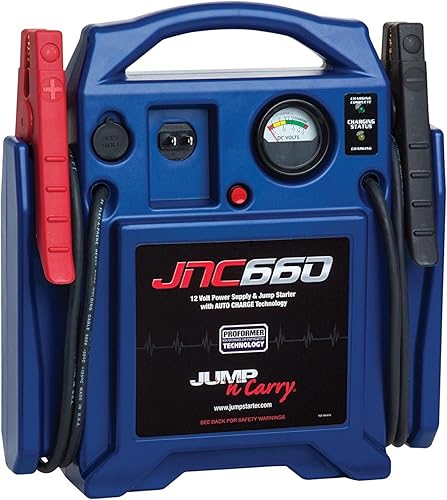
- 1,700 peak amps
- 22Ah lead-acid AGM battery
- 46 in #2 AWG cables
- 12V DC outlet
This shop-style AGM unit has 46-inch cables, a charge-status voltmeter and a 12V accessory outlet. Its 18 lb weight makes it less suited to frequent carrying.
Pros
- 46 in heavy-duty cables
- 12V accessory outlet
- Built-in charge-status voltmeter
Cons
- 18 lb weight
- No engine-size range stated
The Clore JNC660 is a shop-style choice with long cables and a 12V accessory outlet. Its 46-inch #2 AWG leads provide reach, while a voltmeter shows the onboard battery's charge status.
It uses a 22Ah lead-acid AGM battery and provides 1,700 peak amps. The 12V DC outlet can power accessories, but its 18 lb weight makes it less convenient to carry than the lithium picks.
Clore does not state an engine-size range for this model. Check your vehicle's requirements before relying on the peak-amp figure alone.
Choose it for cable reach and an easy-to-read charge status in a 12V setup. Skip it if you need a published engine-size range or a lightweight emergency pack.
For more on battery styles, read lithium vs lead-acid jump starters.
Clore JNC770R: Best for extra-long leads

- 1,700 peak amps
- 68 in 2 AWG welding cable leads
- 425 cranking amps
- Built-in 3A automatic charger
The JNC770R has the longest stated leads here, a master on/off switch and a built-in automatic charger. It is a 23 lb shop-focused 12V model.
Pros
- 68 in welding cable leads
- Master on/off switch
- Automatic charger included
Cons
- 23 lb weight
- No engine-size range stated
The JNC770R suits a garage or workshop where extra cable length matters. Its 68-inch 2 AWG welding cable leads are the longest stated here, and its Powerjaw clamps are made for heavy duty use.
A built-in 3A automatic charger helps keep it ready when connected to power. The master on/off switch provides a separate way to control the unit.
It delivers 1,700 peak amps and 425 cranking amps, weighs 23 lb and is a 12V model. Clore does not state an engine-size range, so confirm fit with the vehicle requirements before buying.
Choose it when long leads and an onboard charger matter more than easy carrying. Skip it for 24V equipment or when you need a model with a stated engine-size fit.
Avapow TJ68: Best for screen-based status

- 10,000 amps stated
- 4 in HD display
- 65W bidirectional charging
- Force Start function
A 4-inch display shows battery level, jump-ready status and error alerts. The Force Start function is intended for critically low batteries.
Pros
- 4 in display
- 65W bidirectional charging
- Carrying case included
Cons
- No specific engine-size limit stated
- Wait 10–15 minutes after a successful start before reuse
The Avapow TJ68 stands out for its screen and high stated peak-current figure. It delivers 10,000 amps and has a 4-inch display showing battery level, jump-ready status and error alerts.
Its 65W bidirectional USB-C port can charge the unit or power a phone, tablet, laptop or camera. A Force Start function is intended for critically low batteries.
No specific engine-size limit is stated, so the amp figure alone cannot confirm fit for your truck or diesel engine. Avapow advises waiting 10 to 15 minutes after a successful start before using it again.
Choose it if a readable status display and two-way charging are priorities. Skip it if you need a clearly stated engine-size range; confirm compatibility and voltage before relying on it.
Clore JNC1224: Best for 24V shop equipment

- 3,400 peak amps in 12V mode
- 1,700 peak amps in 24V mode
- 46 in #2 AWG welding cable leads
- Automatic charging
This lead-acid unit switches between 12V and 24V modes and includes automatic charging. Its 40 lb weight makes it a better fit for a shop than for roadside carrying.
Pros
- Supports 12V and 24V modes
- Automatic charging
- Industrial-grade clamps
Cons
- 40 lb weight
- No engine-size range stated
The Clore JNC1224 is the strongest fit for work that needs both 12V and 24V starting. It provides 3,400 peak amps in 12V mode and 1,700 peak amps in 24V mode, with a change between voltage settings.
This lead-acid AGM unit weighs 40 lb and has 46-inch #2 AWG welding cable leads. Industrial-grade clamps and built-in automatic charging suit a fixed workshop or service area.
No engine-size limits are stated for this model. Verify the vehicle's voltage and engine requirements before choosing it.
Choose it for multi-voltage work when moving the unit often is not a concern. Skip it for a portable roadside kit or if you need a stated engine-size range.
Schumacher DSR119: Best for AGM garage use

- 1,800 amps
- AGM battery
- 225 cold-cranking amps
- 12V DC accessory outlet
The DSR119 is an AGM-powered option rated for engines up to 8.0L gas and 6.0L diesel. Its accessory outlet adds use around a garage or vehicle.
Pros
- AGM battery
- 225 cold-cranking amps stated
- 12V accessory outlet
Cons
- 17.5 lb weight
- 12V only
The Schumacher DSR119 fits a shop or vehicle kit that calls for an AGM unit and a stated diesel range. Schumacher rates it for gas engines up to 8.0L and diesel engines up to 6.0L.
It delivers 1,800 amps, with 280 cranking amps and 225 cold-cranking amps. Heavy-gauge cables, professional-grade clamps and a 12V DC accessory outlet round out its core features.
The unit weighs 17.5 lb and uses a sealed lead-acid battery. Its output is 12V, so choose another model if you need 24V support.
Pick it when your engine fits and an AGM shop unit suits your setup. Skip it if weight is a major concern or you need dual-voltage support.
Yesper 12V/24V 6000A: Best for portable dual voltage

- 6,000 amps
- 12V and 24V support
- 5.1 lb weight
- 145W AC adapter
YESPER combines 12V and 24V support in a 5.1 lb package. For a completely dead battery, its instructions call for manually selecting the voltage.
Pros
- 12V and 24V support
- 145W adapter included
- USB charging ports
Cons
- Manual voltage selection for completely dead batteries
- Engine-size limits are not specified
The YESPER 12V/24V 6000A combines multi-voltage support with a weight of 5.1 lb. It claims 6,000 amps and up to 65 starts per charge.
For a completely dead battery, YESPER says to select 12V or 24V manually. It includes a 145W AC adapter and claims a full charge takes about an hour.
No specific engine-size limits are stated. Check the instructions for your vehicle and select the correct voltage before use.
Choose it if you need a lighter 12V/24V option and are comfortable selecting the voltage manually. Skip it if you need a clearly stated engine-size limit.
The Clore JNC1224 is a much heavier alternative with stated output in each mode.
How do you choose a heavy duty jump starter by engine and voltage?
Match the starter's stated engine range to your engine size, then confirm the vehicle's voltage. A high peak-amp number does not make a unit a match if its engine range or voltage is wrong.
The GBX155 is rated for up to 10.0L gas and 8.0L diesel engines, while the GBX75 reaches 8.5L gas and 6.5L diesel. If your engine exceeds a model's stated range, compare another unit or confirm compatibility with the manufacturer.
Engine size does not tell you whether the vehicle uses 12V or 24V. Check the vehicle manual or battery label before connecting a starter.
Some models in this group do not have stated engine-size limits. For the JNC660, JNC770R, JNC1224, Avapow TJ68 and YESPER, confirm compatibility for your specific vehicle instead of treating peak amps as a substitute.
When does a heavy duty vehicle need a 24V jump starter?
A 24V starter is necessary when the vehicle or equipment uses a 24V electrical system. Do not connect a 12V-only unit to a 24V system.
The Clore JNC1224 has separate 12V and 24V modes. YESPER also supports both voltages, though its instructions call for manually selecting the voltage when starting a completely dead battery.
If you're unsure which system your vehicle uses, check its manual or ask a qualified mechanic before connecting clamps. Engine size does not determine voltage.
Should you choose lithium or lead-acid for heavy duty work?
Lithium models in this group are generally lighter, while lead-acid options offer several shop-focused features. Compare weight and storage needs alongside the vehicle fit.
The GBX75 weighs 5 lb, while the Clore JNC660 weighs 18 lb and has 46-inch leads and a charge-status voltmeter. The 40 lb JNC1224 adds 24V support and automatic charging.
A heavier unit can make sense in a fixed shop, especially when longer leads or multi-voltage operation matter. For a trunk or roadside kit, consider whether you'll be comfortable lifting and storing it.
How much cable length should you look for?
Choose cable length based on the battery's location and the space available to position the starter. Longer leads can make it easier to place a shop unit where it stays stable.
The JNC770R has 68-inch leads, and the JNC660 and JNC1224 have 46-inch leads. Cable lengths are not stated for the lithium picks in this group.
Measure the area around the battery and check the vehicle manual for safe clamp placement. Keep cables clear of moving or hot parts while starting the vehicle.
How should you set up and care for a jump starter?
Read the vehicle and jump starter instructions before the first emergency, confirm the voltage, and charge the unit using its specified method. A jump starter is useful only if it is ready and compatible when you need it.
For an AGM model, follow its charging instructions and check its charge indicator or voltmeter where available. The JNC660 includes a voltmeter, while the JNC770R and JNC1224 have built-in automatic chargers.
For lithium models, use the right input and charger for the model. The NOCO Boost X models support 60W USB-C Power Delivery.
The GBX75 notes that a low-wattage phone charger takes significantly longer. YESPER includes a 145W AC adapter.
Store the unit in a secure, dry place where it won't shift or be crushed by cargo. Keep clamps protected from contact with metal objects, and inspect cables and clamps for damage before use.
Avapow advises fully charging the TJ68 before first use or after a long idle period, recharging every 2 to 3 months, and waiting 10 to 15 minutes between successful starts. Follow the instructions for your specific model, since charging and recovery steps vary.
What mistakes should you avoid with a heavy duty jump starter?
The most costly mistake is connecting a starter before confirming the vehicle's voltage. A 12V-only model is not suitable for a 24V system.
Don't select by peak amps alone. Check the stated gas or diesel engine range, and be cautious with models that do not publish one.
Don't assume a low battery will trigger a standard start mode. The GBX75 manual override and the Avapow TJ68 Force Start are special features with model-specific instructions; use them only as directed.
Don't keep trying repeatedly without following the unit's rest and recovery instructions. Avapow advises a 10 to 15 minute wait after a successful start before reusing the TJ68.
Which best heavy duty jump starter should you choose?
Choose the NOCO Boost GBX155 for the broadest stated 12V engine range in this group. Pick the GBX75 for a lighter lithium pack, the JNC770R for 68-inch leads, or the JNC1224 for 24V support.
Start with engine fit and voltage, then decide whether portability, cable reach or charging features matter most. For a vehicle-based shortlist, see our pickup truck jump starter guide.
Our top 3 picks at a glance
-
1
-
2
-
3
Frequently asked questions
What makes a jump starter heavy duty?
A heavy duty jump starter has the right stated output, voltage and engine compatibility for the vehicle it needs to start. Check the engine-size range and voltage before comparing extras.
Peak amps alone don't confirm that a unit matches a particular engine.
Can a portable jump starter start a diesel truck?
Some portable models are rated for diesel engines, but their stated limits vary. The NOCO GBX155 is rated for diesel engines up to 8.0L, while the GBX75 is rated up to 6.5L.
Match the model's published engine range and voltage to your truck.
Do I need a 24V jump starter for a truck?
Some trucks and equipment use 24V systems, while others use 12V. Confirm the vehicle's system voltage before connecting a jump starter.
The Clore JNC1224 and YESPER support both 12V and 24V, though YESPER calls for manual voltage selection on a completely dead battery.
Are lithium or lead-acid jump starters better for heavy duty use?
Lithium models are often lighter and easier to carry, while lead-acid shop units can offer long cables, accessory outlets or multi-voltage options. The YESPER weighs 5.1 lb, while the Clore JNC1224 weighs 40 lb and supports 24V.
Choose by job, voltage and storage location.
Can a jump starter handle a completely dead battery?
Some models include a Force Start or manual-override feature for batteries too low for normal detection. The GBX75 has manual override for batteries below 3V, and the Avapow TJ68 has a Force Start function.
Follow the unit's instructions because the override steps differ by model.