Lithium vs Lead-Acid Jump Starters: Which Is Better? (October 2026)
Choose a lithium jump starter for a lighter portable pack, or lead-acid for a larger, heavier unit. Compare the battery type, vehicle needs, storage space and charging features before you buy.
On this page (9 sections)
- What is the main difference between lithium and lead-acid jump starters?
- Which jump starter is lighter and easier to carry?
- Which jump starter fits your engine?
- What charging features come with each battery type?
- Which features can help in an emergency?
- How should you choose between these three?
- Are lithium jump starters worth the lighter weight?
- What should you check before buying a lithium or lead-acid starter?
- Which jump starter type should you choose?
Choose the NOCO Boost GB40 if you want a lighter portable pack, or the Clore JNC660 if you prefer a lead-acid unit and can store a heavier jump starter. The Hulkman Alpha85 is another lithium choice, with higher stated engine limits than the GB40.
The NOCO Boost GB40 and Hulkman Alpha85 use lithium batteries. The Clore JNC660 uses a lead-acid, AGM battery and weighs 18 lb, compared with 2.4 lb for the GB40 and 4.5 lb for the Alpha85.


What is the main difference between lithium and lead-acid jump starters?
The lithium jump starters here weigh less, while the lead-acid Clore JNC660 weighs 18 lb and has a 22 Ah battery. Weight affects where you can store a unit and how easy it is to carry to a disabled vehicle.
The GB40 weighs 2.4 lb, and the Alpha85 weighs 4.5 lb. The JNC660 weighs 18 lb, so it may suit a vehicle or garage where you can leave it in one place.
Battery type alone doesn't tell you which jump starter fits your car. Check the model's vehicle guidance, peak current, cable reach and charging instructions.
How does battery type affect storage?
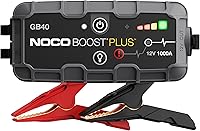
The NOCO GB40 is the lightest model here at 2.4 lb. NOCO describes it as sized for glove boxes and emergency kits.
The Alpha85 weighs 4.5 lb and includes a smart display and multiple charging outputs.
The Clore unit weighs 18 lb and measures 16.3 in high, so plan where it will sit and whether you can lift it comfortably when needed.
Hulkman recommends avoiding extreme temperatures when charging or storing the Alpha85 and recharging it at least every 3 months. Check the instructions for any jump starter you buy, especially if it will stay in a vehicle through hot summers or cold winters.
Which jump starter is lighter and easier to carry?
The NOCO GB40 is the lightest option here at 2.4 lb. Choose it when compact storage and carrying ease are priorities, and its engine guidance fits your vehicle.
The Alpha85 weighs 4.5 lb, still far below the JNC660's 18 lb. Its 3.3 in display shows operating status, battery level and possible errors.
The JNC660 has 46 in heavy-duty cables. That extra reach can help with positioning, but its weight makes it less convenient to carry between vehicles.
For more compact options, see our guide to portable jump starters for a glovebox. If you need the basics on how these packs work, start with what a jump starter is.
Which jump starter fits your engine?
Match the jump starter's stated engine limits to your vehicle before comparing battery types. Peak current by itself does not guarantee fit for every engine.
The GB40 is rated for engines up to 6.0L gas and 3.0L diesel. The Alpha85 is rated for up to 8.5L gas and 6.0L diesel.
The JNC660 has 1700 peak amps, but no engine-size limit is given here.
For a large truck or SUV, the Alpha85 has the clearest engine guidance of these three. Read our guide to jump starters for V8 engines for more help matching a pack to a larger engine.
Cold weather and battery condition can also affect a start. If the battery is completely discharged or damaged, a jump starter may not solve the underlying problem.
Does peak current settle the comparison?
No. Peak-current numbers are one factor, but they don't give a complete measure of starting performance across different models and vehicles.
The GB40 has 1000 A peak current, the JNC660 has 1700 peak amps, and the Alpha85 has 2000 A peak current. Use those figures alongside each model's engine guidance and your vehicle manual.
Don't choose by the largest number alone. A starter with a high peak-current rating still needs to be suitable for your vehicle and connected as its instructions describe.
What charging features come with each battery type?
The Alpha85 has the most detailed charging and output options in this comparison. It includes a 65W wall charger, Type-C USB cable, DC 12V cigarette lighter socket adapter, USB-A QC3.0 output and USB-C PD18W output.
Hulkman says the Alpha85 charges from 0% to 80% in 1 hour and reaches a full charge in 90 minutes. The company also recommends recharging it at least every 3 months, even if the unit is stored.
The GB40 recharges in 3 hours and can power smartphones and tablets through its integrated power bank. The JNC660 includes a DC outlet for 12V accessories and a voltmeter to show onboard battery charge status.
Compare the ports with the devices you plan to power. A power bank or DC outlet is useful only if it matches your cables and equipment.
Which features can help in an emergency?
The GB40 and Alpha85 include a flashlight and device charging features. The JNC660 includes a lead-acid battery, cables, charge-status voltmeter and 12V outlet.
The GB40 has a 100-lumen LED flashlight with 7 modes, including SOS and strobe. Its integrated power bank can provide emergency power to smartphones and tablets.
The Alpha85 has a built-in flashlight with 5 modes and a screen that shows operating status, battery level and possible errors. Its intelligent clamps include spark-proof and reverse-polarity protection.
Clore lists 46 in heavy-duty cables and a voltmeter for the JNC660. Use the instructions when connecting it.
How should you choose between these three?
Choose by weight first if you'll carry the unit, then confirm engine fit and the features you need. Battery type is one part of the decision, but it doesn't replace those checks.
Pick the NOCO Boost GB40 for compact storage and a 2.4 lb lithium pack when its engine limits fit. It has 1000 A peak current and is rated for up to 20 starts per charge.
Choose the Hulkman Alpha85 if you need the highest stated engine limits in this comparison, a display, or more charging outputs. It weighs 4.5 lb and needs periodic recharging during storage.
Consider the Clore JNC660 if you prefer a lead-acid unit, want 46 in cables and can store an 18 lb jump starter. Its 1700 peak amps are listed without an engine-size recommendation here.
Our guide to using a car jump starter covers connection steps and safe handling. Always follow the vehicle and jump-starter manuals.
Are lithium jump starters worth the lighter weight?
Lithium can be a practical choice when you want a compact pack you can carry easily. The GB40 and Alpha85 weigh far less than the JNC660, and both include features beyond jump starting.
A lead-acid model may fit your preference if you have room for a heavier unit and value the JNC660's long cables and charge-status voltmeter. These three models don't mean one battery type is best for every driver.
Choose lithium for a lighter pack, then match its engine rating to your car or truck. Choose the JNC660 if its lead-acid format and features suit your storage space and needs.
Our score weighs specs, features and buyer feedback against what you're shopping for.
What should you check before buying a lithium or lead-acid starter?
Confirm your vehicle's voltage, engine type and size, then compare them with the jump starter's instructions. Also check the unit's weight, storage dimensions and charging routine.
Keep the pack charged according to its manufacturer and inspect the cables before an emergency. A portable starter cannot repair a worn-out battery or guarantee that a vehicle will start.
If you're unsure whether the battery is the cause, have the vehicle checked. A jump starter is emergency equipment, not a substitute for diagnosing a recurring starting problem.
Which jump starter type should you choose?
Pick lithium if low weight and compact storage matter most; pick lead-acid if you prefer that battery format and can accommodate a larger unit. Then compare engine guidance and charging needs for the exact model.
The GB40 is the easiest to carry, the Alpha85 covers the largest stated engine sizes here, and the JNC660 offers a lead-acid option with long cables. Use our portable jump starter guide to compare more compact choices.
Frequently asked questions
Are lithium jump starters better than lead-acid?
Lithium jump starters in this comparison are lighter: the NOCO GB40 weighs 2.4 lb and the Hulkman Alpha85 weighs 4.5 lb. The Clore JNC660 uses a lead-acid, AGM battery and weighs 18 lb.
Compare each model's engine guidance, peak current, storage needs and charging features to choose.
How long can a lithium jump starter hold its charge?
The Hulkman Alpha85 can hold power for up to 18 months when fully charged. Hulkman also recommends recharging it at least every 3 months to extend its lifespan.
Follow the instructions for the exact starter you choose.
Does a lead-acid jump starter need maintenance?
Keep the unit charged enough for an emergency and follow the manufacturer's charging and storage instructions. The Clore JNC660 has a built-in voltmeter that shows the onboard battery's charge status.
Store it where its size and weight won't make it hard to access.
Can a lithium jump starter start a dead battery?
The NOCO GB40 and Hulkman Alpha85 are designed to start dead batteries within their stated engine limits. The GB40 is rated for engines up to 6.0L gas and 3.0L diesel, while the Alpha85 supports up to 8.5L gas and 6.0L diesel.
Follow each model's instructions.