How Much Is a Portable Jump Starter?
A portable jump starter usually costs from about 50 dollars to 250 dollars, depending on engine size, peak amps and smart features. Most drivers do well in the 100 dollars to 150 dollars middle, where units start 6.0L gas engines and hold a charge for months between uses.
On this page (8 sections)
- What drives the price of a portable jump starter?
- How much do budget jump starters cost?
- How much should most drivers spend?
- What do premium jump starters cost, and who needs one?
- Which jump starters fit each price tier?
- What extra costs should you budget for?
- Does spending more mean a longer-lasting jump starter?
- So how much is a portable jump starter worth?
A portable jump starter usually costs from about 50 dollars to 250 dollars, depending on engine size, peak amps and smart features. Most drivers do well in the middle range, where units start 6.0L gas engines and hold a charge for months in the glovebox.
The price you pay tracks the power inside the case. A 1,000-amp unit and a 4,000-amp unit look similar from the outside, but they are built for very different engines and budgets.
Here is what each tier buys and where the money actually goes.
What drives the price of a portable jump starter?
Peak amps and battery capacity set most of the price, followed by smart screens, fast charging and power bank ports. A unit rated for 6.0L gas engines needs a bigger lithium pack than one built for a 2.0L commuter car.
The lithium cell inside is the single largest cost. More peak amps means more cells and thicker internal wiring, so the case grows and the weight climbs with the rating.
That is why a 4,000-amp unit costs several times what a compact 1,000-amp model does.
Safety electronics add cost too. Spark-proof clamps and reverse polarity protection need sensing circuits that a plain jumper pack doesn't have.
If you're still deciding whether you need one at all, read what a jump starter is and when you need one.
Features are the third cost. A smart display, USB-C fast charging and a built-in flashlight all add to the bill, even though they don't start a bigger engine.
They matter more for everyday use than for raw power.
How much do budget jump starters cost?
Budget jump starters sit at the bottom of the price range and are built for small engines. Think motorcycles, lawn mowers, small cars and ATVs, where a modest peak rating is enough to turn the engine over.
The trade-off is headroom. A low-amp unit that starts a 2.0L sedan may struggle with a 5.0L truck on a cold morning.
If your household has one large vehicle and one small one, a budget unit can leave you short.
Warranty length and charging speed are the other differences. Budget models often recharge more slowly and carry shorter coverage than the mid-range class.
Neither affects a single emergency start, but both matter if the unit lives in the car for years.
How much should most drivers spend?
The middle of the range is the sweet spot for most drivers. That tier covers gas engines up to about 6.0L and diesel up to about 3.0L, which handles a family sedan, a crossover and many light trucks.
You also get real safety electronics at this level. Reverse polarity protection and spark-proof clamps mean a mistaken connection won't fry the unit or the car's electronics.
For a first jump starter, those features are worth more than an extra 1,000 amps you'll never need.
Charge speed improves here as well. Faster charging means the unit spends less time on the wall and more time ready to go.
Check your engine size on the vehicle badge or in the manual before you compare models.
What do premium jump starters cost, and who needs one?
Premium jump starters cost the most and are rated for the largest engines, often 8.5L gas and 6.0L diesel and beyond. Pickup owners, RV drivers and people with tractors or boats get real value from that extra headroom.
You also pay for convenience. Big smart screens, one-hour recharge times and multiple power outputs (USB-C, USB-A and 12V DC) all sit at this end.
These extras matter if the unit doubles as a power bank for phones, tire inflators or a laptop.
The rule is simple. If your engine is under 6.0L gas or 3.0L diesel, premium amps are money spent on a capability you won't use.
If you tow a trailer or drive a diesel, the bigger unit is the safer buy.
Which jump starters fit each price tier?
NOCO Boost GB40: best value for most drivers
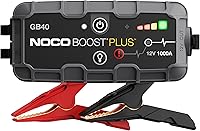
The NOCO Boost GB40 packs 1,000 amps into a 2.4 lb case rated for 6.0L gas and 3.0L diesel engines. NOCO says it delivers up to 20 starts per charge and recharges in about 3 hours.
It's the pick for a typical car owner who wants one unit in the glovebox. The patented spark-proof and reverse polarity protection make connections forgiving, and the 100-lumen LED has 7 modes including SOS.
The IP65 housing resists water and dust. NOCO backs it with a 1-year warranty.
Our score of 9.3 weighs its specs, features and buyer fit against what most drivers actually need. It leads our list of the best portable jump starters for the glovebox.
Hulkman Alpha85: best for fast recharge and smart readouts
The Hulkman Alpha85 steps up to 2,000 amps peak and 8.5L gas or 6.0L diesel engines. A 3.3-inch smart screen shows battery level and status, so you're not guessing before you clamp on.
The 65W Speed Charge tech takes it from 0% to 80% in about 1 hour and full in 90 minutes. Hulkman says a 5-minute charge is enough for one emergency jump.
It also has 10 safety layers and a 2-year guarantee. The Alpha85 is the better buy for someone who wants faster top-ups and a clear display, at a higher price than the GB40.
Our score is 8.4.
Gooloo GT4000S: best for large trucks and RVs
The Gooloo GT4000S delivers 4,000 amps peak and is rated for 12.0L gas and 10.0L diesel engines. That is the highest engine rating here, aimed at pickups, RVs and tractors.
GOOLOO's JUMPCORE tech and a 3.2-inch LED screen round out the package. It recharges 0% to 100% in about 1.2 hours with the included 100W car charger, and a full charge supports up to 60 starts.
Three USB ports, a 400-lumen flashlight and a 15V/10A DC output let it double as a roadside power source. Our score is 8.4.
It costs the most of the three and suits drivers whose engine really needs the amps.
What extra costs should you budget for?
The jump starter is the main cost, but a few extras can add to the bill. None are required on day one, yet each changes how useful the unit is over time.
- A longer charging cable: many units ship with a short cable, and a longer one helps in awkward parking spots.
- A storage bag or case: some units include one, but a dedicated case keeps clamps from rattling in the trunk.
- A 12V socket charger: useful for topping up on the road instead of at a wall outlet.
Skip accessories you won't use. A case is worth it if the unit bounces around a truck bed.
A 12V charger earns its keep on long trips. Otherwise the included kit covers a normal emergency.
Does spending more mean a longer-lasting jump starter?
Not directly. A mid-range unit kept charged and stored in a cool spot can outlast a premium one left in a hot trunk for a year.
Battery care matters more than the price tag.
Lithium cells lose charge slowly in storage. Recharge every 2 to 3 months, even if the unit hasn't been used, and avoid leaving it in extreme heat or cold.
Both steps extend the life of any unit, whatever you paid.
Warranty coverage is the real difference when something goes wrong. The NOCO GB40 carries 1 year, while the Hulkman Alpha85 carries 2 years.
Longer coverage reduces the long-term cost of ownership. Use how to use a car jump starter so the first real emergency goes smoothly.
If the battery is already flat, read more about jump starters for a dead battery before you buy.
So how much is a portable jump starter worth?
How much a portable jump starter costs depends on the engines you need to start. Spend in the middle for a family car and the NOCO Boost GB40 at 9.3 covers most 6.0L gas and 3.0L diesel engines for years.
Step up to the Hulkman Alpha85 for a smart screen and fast recharge, or the Gooloo GT4000S for a large truck or RV.
The cheapest unit is not automatically the best value. A model that fails on a cold morning costs more in frustration than the few dollars it saved.
Buy for your largest engine, not your smallest, and recharge it on a schedule so the price you paid keeps paying you back.
Compare the full field in our portable jump starter buying guide.
Frequently asked questions
Do portable jump starters go on sale?
Yes, prices move around holiday events and back-to-school periods. A jump starter you can use today beats a small discount next month, so compare the tier you need rather than waiting for the lowest price.
Is a cheap jump starter safe to keep in the car?
Safety comes from the protection features, not the price. Look for spark-proof clamps and reverse polarity protection, which stop a wrong connection from damaging the unit or your vehicle's electronics.
How often do I need to recharge a jump starter?
Recharge it every 2 to 3 months when it sits in storage, even if you never use it. Lithium cells lose charge slowly, and a unit that sat for a year may not have enough power for a cold start.
Does a bigger jump starter always cost more?
Broadly yes, because higher peak amps need a larger lithium pack. The jump is not perfectly linear: screen size, fast charging and power bank ports also push the price up, so a compact 1,000-amp unit can cost less than a feature-heavy mid-range model.
Can I use one jump starter for a car and a motorcycle?
Yes, if the unit's rating covers both. A 1,000-amp unit for a 6.0L gas car will start a motorcycle easily, while the smallest units meant for bikes may strain on a large truck engine.