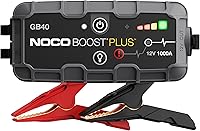
NOCO GB40 vs GB50: Which Is Better? (October 2026)
The NOCO GB40 vs GB50 choice comes down to engine size and how much reserve you want: the GB40 suits engines up to 6.0L gas or 3.0L diesel, while the GB50 reaches 7.0L gas or 4.5L diesel.
On this page (8 sections)
- NOCO GB40 vs GB50: which jump starter fits your vehicle?
- How much extra capacity does the GB50 give you?
- Which one is easier to carry and store?
- When does the GB40's shorter recharge time matter?
- What features do the GB40 and GB50 share?
- How should you set up and care for either NOCO jump starter?
- What common mistakes should you avoid?
- Should you buy the GB40, GB50 or GBX45?
The NOCO GB40 suits engines up to 6.0L gas and 3.0L diesel; the GB50 suits engines up to 7.0L gas and 4.5L diesel. In this NOCO GB40 vs GB50 comparison, choose by your vehicle's engine size first, then decide whether lower weight and quicker recharging or more starting reserve matter more.
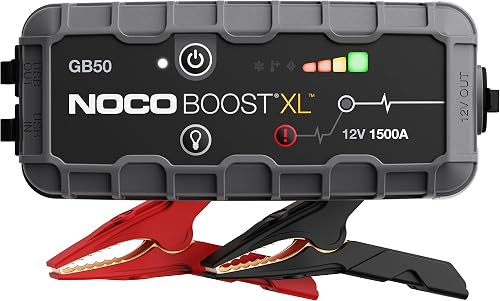
The GB40 is rated at 1,000 amps and the GB50 at 1,500 amps. Both are 12V lithium jump starters with spark-proof and reverse polarity protection, a power bank, a 7-mode LED flashlight and an IP65-rated housing.

NOCO GB40 vs GB50: which jump starter fits your vehicle?
Choose the GB40 when your engine is within its limits and you want the lighter unit; choose the GB50 when you need its higher engine limits or extra starts per charge. The GB40 is rated for up to 20 starts per charge, while the GB50 is rated for up to 30.
Start with the engine size in your vehicle manual or under-hood information. If you have a 5.0L gas engine, for example, both models fall within their stated ranges; if your gas engine is larger than 6.0L, only the GB50 of these two reaches up to 7.0L.
The same check applies to diesel. The GB40 tops out at 3.0L diesel, while the GB50 reaches 4.5L, so a diesel owner close to or above the GB40 limit has a clear reason to choose the larger model.
A truck or SUV's V8 badge doesn't give you the displacement by itself. Check the actual engine size, then use our guide to jump starters for V8 engines if you need help matching the unit to a larger vehicle.
How much extra capacity does the GB50 give you?
The GB50 adds 500 amps of peak output, raises the gas limit by 1.0L and raises the diesel limit by 1.5L. That added range is useful when your vehicle falls beyond the GB40's limits or you want more headroom for other compatible vehicles.
The GB40's 1,000 amps pair with an engine range up to 6.0L gas and 3.0L diesel. The GB50's 1,500 amps pair with limits up to 7.0L gas and 4.5L diesel.
Peak amps are only one part of the match. Confirm that the engine is in range, then consider starts per charge and how often you can recharge the unit.
Does the NOCO GB40 vs GB50 amp difference mean more starts?
No, compare the starts-per-charge ratings separately from peak amps. NOCO rates the GB40 for up to 20 starts per charge and the GB50 for up to 30.
Those figures are maximums, and actual results can vary with battery condition, temperature, engine and use. They are useful for comparing the models, but they are not a promise that each vehicle will get the same number of starts.
The GB50's higher maximum can be useful if you carry one jump starter for more than one compatible vehicle or want additional reserve between charges. If you only need an emergency unit for a single car, the GB40 may already provide enough capacity for your routine.
Which one is easier to carry and store?
The GB40 is the lighter option at 2.4 lb, compared with 3.3 lb for the GB50. Their dimensions are close, so weight and the shape of your storage space matter more than a large size difference.
The GB40 measures 4.61 x 8.19 x 4.21 in. The GB50 measures 4 x 8.25 x 4.75 in.
Both fit the general role of a vehicle emergency unit, but check your own compartment before choosing a storage spot. Leave enough room to remove the unit and handle its clamps without having to empty the whole space.
Each model includes heavy-duty clamps, a USB-C charging cable and a microfiber storage bag. For a compact emergency setup, see our advice on portable jump starters for the glovebox.
When does the GB40's shorter recharge time matter?
The GB40 recharges in 3 hours, while the GB50 takes 5 hours. If you use the jump starter, recharge it afterward and give it time to be ready before returning it to your vehicle.
The shorter recharge window can suit someone who wants a lighter unit and can top it up between uses. The GB50 takes longer, but pairs that charge time with a higher engine range and up to 30 starts per charge.
Both models include a USB-C charging cable. Follow the manual for charging and storage, and don't assume a brief plug-in has fully restored the unit after use.
The NOCO GBX45 is another option if fast USB-C Power Delivery charging is a priority. It recharges in 48 minutes with a compatible source, supports 60W two-way USB-C power and is rated for up to 6 starts per charge.
What features do the GB40 and GB50 share?
Both models include spark-proof connections and reverse polarity protection, plus an integrated power bank and flashlight. These shared features mean that engine limits, carry weight and recharge routine are the clearest ways to separate them.
Both have an IP65-rated housing with rubberized over-molding. Each model includes a one-year warranty, heavy-duty clamps, a USB-C charging cable and a microfiber storage bag.
The flashlight differs: the GB40 is rated at 100 lumens and the GB50 at 200 lumens. Both offer 7 light modes, including SOS and strobe, which can be useful when setting up in a dark area.
Protection features are there to help reduce connection mistakes, but they don't replace careful setup. Read our step-by-step guide to using a car jump starter before connecting either model.
How should you set up and care for either NOCO jump starter?
Read the manual, charge the unit before relying on it and keep the clamps away from loose metal. A jump starter is an emergency tool, so a little preparation at home makes the roadside setup more straightforward.
Before storing it in a vehicle, check that the unit is charged and that the clamps and cable are together in the storage bag. Keep the manual accessible, and choose a storage spot where the unit can be reached without unloading heavy items.
When you need a jump, park safely, switch off the vehicle and follow the instructions for your model and vehicle. Inspect the clamps and cables for damage, connect them in the instructed order, and keep the leads clear of moving parts before attempting a start.
Remove the clamps in the order the manual specifies once the vehicle starts. Recharge the jump starter afterward, and return it to its storage place only when it is ready for the next emergency.
What common mistakes should you avoid?
The biggest mistake is choosing by peak amps alone instead of checking the engine limit. A 1,500-amp rating does not make a jump starter a fit for every vehicle, so confirm displacement and fuel type first.
Don't confuse a gas engine limit with a diesel limit. The GB40 reaches 6.0L gas but 3.0L diesel; the GB50 reaches 7.0L gas but 4.5L diesel.
Another common mistake is leaving the unit unused after a jump without restoring its charge. Since the GB40 and GB50 take different amounts of time to recharge, plan for that step instead of assuming either will be ready later.
Finally, don't let protection features encourage rushed connections. Spark-proof and reverse polarity protection can help reduce risk, but correct clamp placement and the vehicle's own instructions still matter.
Should you buy the GB40, GB50 or GBX45?
Pick the GB40 for a vehicle within its engine range when lower carry weight and a 3-hour recharge suit you; pick the GB50 when its higher engine limits and up to 30 starts per charge are useful. Consider the GBX45 when fast USB-C Power Delivery charging matters and its range fits your vehicle.
- Choose the GB40 for up to 6.0L gas or 3.0L diesel, 2.4 lb carry weight and up to 20 starts per charge.
- Choose the GB50 for up to 7.0L gas or 4.5L diesel, up to 30 starts per charge and a 200-lumen flashlight.
- Consider the GBX45 for up to 6.5L gas or 4.0L diesel, 48-minute USB-C Power Delivery recharging and 60W USB-C output, while accepting its up to 6 starts per charge.
If both the GB40 and GB50 cover your engine, choose the GB40 when compact carry and shorter recharge time matter more. Choose the GB50 when extra engine range and more starts per charge make the added weight worthwhile; our NOCO jump starter model guide compares other options in the range.
Frequently asked questions
Is the NOCO GB50 better than the GB40?
The GB50 suits larger engines and gives you more starts per charge, while the GB40 is lighter and recharges sooner. The GB50 has 1,500 amps and is rated for up to 7.0L gas and 4.5L diesel; the GB40 has 1,000 amps and is rated for up to 6.0L gas and 3.0L diesel.
Match the engine limit first, then consider weight and recharge time.
Can the GB40 start a V8?
The GB40 is rated for gas engines up to 6.0L, so check your vehicle's engine displacement before choosing it. A V8 label alone doesn't tell you the engine size.
If your engine is larger than 6.0L, compare the GB50's stated limit of 7.0L gas and follow your vehicle and jump starter instructions.
How many starts can the GB40 and GB50 provide?
NOCO rates the GB40 for up to 20 starts per charge and the GB50 for up to 30. Actual results can vary with battery condition, temperature, engine and use.
Keep the unit charged and follow its instructions so it is ready when needed.
How long do the GB40 and GB50 take to recharge?
The GB40 recharges in 3 hours and the GB50 in 5 hours. Allow enough time to recharge after a jump and before storing either unit for an emergency.
Use the included USB-C charging cable and follow the manual's charging and storage directions.
What is the difference between the NOCO GB50 and GBX45?
The GB50 supports up to 7.0L gas and 4.5L diesel engines and provides up to 30 starts per charge. The GBX45 supports up to 6.5L gas and 4.0L diesel, with up to 6 starts per charge.
The GBX45 recharges in 48 minutes with USB-C Power Delivery and can provide 60W USB-C output.