NOCO vs Gooloo Car Jump Starters: Which Fits You? (November 2026)
NOCO wins the noco vs gooloo car jump starters comparison for most drivers because its UltraSafe clamps protect against reversed connections. Pick Gooloo only when you need a bigger engine rating for less bulk, or when you want a specific GT4000S feature.
On this page (8 sections)
NOCO wins the noco vs gooloo car jump starters comparison for most drivers because its UltraSafe clamps are spark-proof and protect against reversed connections. That safety layer matters more than a small gap in peak amps, since a wrong connection is the mistake that ruins a jump start.
Gooloo still earns a place. Its models often pair a strong amp rating with extras like a built-in air compressor or a larger engine ceiling in a smaller shell.
The right pick depends on what you drive and where you store the unit.
This comparison lines up the two brands on the points that change the buying decision: engine coverage, clamp safety, size and weight, charging speed, and what comes in the box. We checked the published specs for both NOCO models and compared how their features line up with real driving needs.
NOCO vs Gooloo: the quick verdict
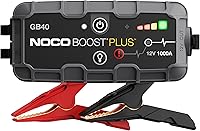
Pick NOCO if you want the safest clamp design and a proven compact booster for a car or small SUV. The GB40 covers gasoline engines up to 6.0 liters and diesels up to 3.0 liters, and its reverse polarity protection means a mixed-up connection won't spark or fry the unit.
Gooloo makes more sense when your engine sits at the top of the range or you want one device to do two jobs. Several Gooloo units ship with an air compressor or a higher peak amp figure at a similar size.
If you drive a diesel truck or tow a trailer, the extra headroom is worth comparing.
The noco vs gooloo car jump starters question has no single winner, because the two brands target slightly different buyers. NOCO leans on safety and simplicity.
Gooloo leans on feature density. Neither approach is wrong, but one will fit your habits better.
One more point shapes the verdict. NOCO rates its units against both gasoline and diesel engine ceilings, so you can check your engine against a stated limit before you buy.
The GB40's 1000 amps are rated for 6.0L gas and 3.0L diesel, and the GB70's 2000 amps are rated for 8.0L gas and 6.0L diesel. Gooloo's range varies more from model to model, so the spec sheet for each unit is the thing to read.
The two NOCO models side by side
The GB40 suits everyday vehicles and the GB70 covers trucks and big diesels. Here is how the two NOCO units compare on the specs that decide the choice.


The GB40 is the lighter option for a daily driver. It weighs 2.5 lb, recharges in about 3 hours and starts engines up to 6.0L gas and 3.0L diesel.
The GB70 doubles the peak amps to 2000 A and raises the engine ceiling to 8.0L gas and 6.0L diesel, but it weighs 5.0 lb and needs 6 hours to recharge.
Both share the same UltraSafe design. Clamps are spark-proof and guard against reverse polarity, so connecting them the wrong way around won't cause a short.
Both also include a USB-C power bank, an LED flashlight with 7 modes and an IP65-rated housing.
The trade-off is straightforward: the GB40 is easier to carry and quicker to top up, while the GB70 starts bigger motors and delivers up to 40 starts per charge instead of 20.
Where the two units differ most
The start count per charge is the spec most shoppers overlook. The GB40 delivers up to 20 starts on a full battery.
The GB70 delivers up to 40. If you run a small fleet or share one booster across several vehicles, the GB70's double count means fewer trips to the charger.
The flashlight output splits the same way. The GB40's LED is rated at 100 lumens, which is plenty for reading a battery label or lighting a wheel well.
The GB70's 400-lumen light throws further and is easier to work by at the side of a road at night. Both carry 7 modes, including SOS and strobe.
Battery capacity follows the amp rating. The GB40's internal battery has 2150 mAh of capacity and the GB70's has 5000 mAh.
That larger reserve is part of why the GB70 starts bigger engines and runs longer between charges, and it is also part of why it takes longer to refill.
Which engine size should you match?
Match the jump starter's engine rating to your vehicle, with a little headroom. An undersized booster may not turn over a cold diesel, and an oversized one costs more and weighs more than you need.
The GB40's 1000 amps handle gasoline engines up to 6.0 liters and diesel engines up to 3.0 liters. That covers most sedans, hatchbacks, small SUVs, motorcycles and ATVs.
A 2.0L four-cylinder or a 3.5L V6 sits well inside the limit.
The GB70's 2000 amps stretch to 8.0L gas and 6.0L diesel. Full-size trucks, heavy SUVs and diesel vans land in that range.
If your engine is close to the GB40's ceiling, the GB70 gives you room for a cold morning when the battery is weak.
Gooloo's lineup spreads across a similar range. Its GT4000S and larger units push into the 2000-amp territory and beyond, while compact models sit near the 1000-amp mark.
The Gooloo GT4000S review breaks down where that model lands against the NOCO options.
If you already know your engine size, this is the first spec to lock in. Everything else is secondary.
Vehicles each NOCO model covers
NOCO lists a broad compatible vehicle type for both units: ATV, motorcycle, passenger car, RV, tractor, truck, UTV, van and watercraft. The difference is not the vehicle list but the engine under the hood.
A motorcycle or an ATV sits far below the GB40's ceiling. A diesel pickup or a large boat motor may need the GB70's 2000 amps.
Watercraft deserve a second look. A marine engine that sits near 3.0 liters of displacement fits the GB40's diesel rating, but bigger inboard motors can move past it.
Check the engine size on the boat before you decide.
Which brand is safer to connect?
NOCO's UltraSafe clamps are the clearer safety story. They're engineered to be spark-proof and to protect against reverse polarity, so a slip of the hand is less likely to damage the unit or the vehicle.
That matters more than most shoppers expect. A jump start goes wrong when clamps touch each other or land on the wrong terminal.
Spark-proof clamps and polarity protection turn those mistakes into a harmless no-start instead of a short circuit.
Gooloo units also include protection circuitry, but the safety design isn't the brand's headline selling point. NOCO built its reputation on UltraSafe and puts it on every Boost model from the GB40 up.
For a first jump starter or a unit you'll hand to a teenager or a partner, the safety layer is worth paying for. For an experienced driver who double-checks connections every time, the difference narrows.
The feature carries onto both NOCO units without an upcharge. The GB40 and the GB70 both meet the UL specification and both ship with heavy-duty booster clamps for maximum energy transfer.
So the safety case holds at either amp level, and the choice comes down to engine size rather than protection.
How much weight and bulk will you carry?
The GB40 is the easier unit to live with day to day. At 2.5 lb and roughly 8.19 inches wide, it fits in a glove box or a door pocket without crowding out the owner's manual.
The GB70 weighs 5.0 lb and measures about 12.6 inches tall. That's still portable, but it takes more space in the trunk and feels heavier when you carry it out to a car in the rain.
Gooloo's compact models compete well on size. Its smaller boosters aim for a glove-box footprint too, while its high-amp units grow closer to the GB70's bulk.
The best Gooloo jump starters roundup lays out which models stay small and which ones trade size for power.
If the unit lives in a commuter car and only comes out a few times a year, lighter wins. If it lives in a truck bed toolbox or a work van, the extra weight of a bigger unit costs you little.
The housing on both NOCO units is IP65-rated with rubberized over-molding. That rating covers water and dust ingress, and the over-molding takes the knocks of being tossed in a trunk.
A lighter unit that lives in the glove box faces fewer drops than a heavier one you lift in and out of a toolbox, but the protection is the same on either model.
How fast does each one recharge?
The GB40 refills faster, which makes it easier to keep ready. It recharges in about 3 hours over USB-C.
The GB70 takes about 6 hours, so it's better suited to a unit you top up overnight rather than between errands.
Recharge time matters because a lithium jump starter loses charge when it sits. A unit that's quick to top up is more likely to be full when you actually need it.
Store either one in a spot where you'll remember to plug it in, like a garage shelf or a desk drawer.
Gooloo's recharge times vary by model. Its larger, higher-amp units generally take longer to fill than its compact ones.
Check the rating on the specific model before you buy, and read up on how do you charge a Gooloo jump starter if you want the step-by-step for that brand.
Either way, the routine is the same: charge it when you bring it home, then top it up on the maker's schedule and before long trips or cold snaps.
Charge time in practice
The 3-hour figure on the GB40 is short enough to fit a lunch break or an evening at home. Plug it in when you get back from a trip and it is ready before the next morning.
The GB70's 6-hour window suits a unit that stays in one place and gets topped up overnight.
Both units use a USB-C charging cable, which is included in the box. If you already carry a USB-C cable for a phone or a tablet, you have a spare for the jump starter too.
That makes keeping either NOCO topped up less of a chore than a unit with a proprietary charger.
What extras come in the box?
Both NOCO units include the clamps, a USB-C cable, a storage bag and a 1-year warranty. The flashlight and power bank come built in on every Boost model, so you don't pay extra for them.
The GB40's LED puts out 100 lumens across 7 modes, including SOS and strobe. The GB70 steps that up to 400 lumens with the same 7 modes.
For roadside repairs after dark, the brighter light on the GB70 is a real advantage.
Both double as USB-C power banks for phones and tablets. That's useful when a dead battery leaves you stranded with a low phone, which is often the case on a winter breakdown.
Gooloo's edge is in specialized extras. Some models add a built-in tire inflator or an AC outlet, turning the jump starter into a small roadside kit.
If you want one device for boosting and inflating tires, that's a Gooloo strength NOCO doesn't match in these two models. The best NOCO jump starters guide shows where the brand's other models sit if you want to stay with NOCO.
What ships with each NOCO unit
The GB40 box holds the jump starter, heavy-duty clamps, a USB-C charging cable, a microfiber storage bag and a user guide. The GB70 box carries the same core items plus an XGC cable and XGC male and female connectors.
That extra cable is part of why the GB70 suits larger vehicles and longer runs to a battery that sits far from the driver's seat.
Both units are backed by a 1-year limited warranty and are engineered in the USA. Neither box includes a wall charger, so plan on charging from a USB port you already own.
The storage bag is the same idea on both: it keeps the clamps from rattling around and protects the housing between uses.
Which brand should you buy?
Most drivers should buy a NOCO, starting with the GB40 for a car or small SUV and the GB70 for a truck or large diesel. The safety design, the compact size of the GB40 and the straightforward feature set make the brand easy to recommend.
Choose Gooloo instead in two cases. First, when your engine sits at the very top of the amp range and you want the highest peak figure for the bulk.
Second, when you'd rather carry one device that jumps the battery and inflates a tire. In those cases, Gooloo's feature set earns its place.
For the typical commuter, the GB40 is the pick. It covers up to 6.0L gas and 3.0L diesel, recharges in 3 hours, weighs 2.5 lb and carries the safety clamps that make the brand's case in this noco vs gooloo car jump starters comparison.
Step up to the GB70 only when your engine needs the extra 1000 amps.
Whichever you choose, keep it charged and stored where you can reach it. A jump starter that's flat when the battery dies is no help at all.
Frequently asked questions
Is NOCO better than Gooloo for jump starters?
NOCO is the safer default for most drivers because its UltraSafe clamps are spark-proof and protect against reversed connections. Gooloo is worth a look when you want more peak amps for the money or a model with a specific feature, such as a built-in air compressor.
What size jump starter do I need for my car?
Match the amp rating to your engine size. A 1000-amp unit like the NOCO GB40 covers gasoline engines up to 6.0 liters and diesels up to 3.0 liters.
Move to a 2000-amp model when you drive a truck or a diesel above 3.0 liters.
Can a jump starter damage my car's electronics?
A jump starter with reverse polarity protection and spark-proof clamps is designed to prevent the most common mistakes. Connect the clamps to the correct terminals and follow the unit's instructions.
NOCO's UltraSafe design is built around this protection.
Do NOCO and Gooloo jump starters work as power banks?
Yes. The NOCO GB40 and GB70 both include a USB-C power bank for phones and tablets.
Gooloo models generally include USB outputs too.
Check the port type on the model you choose so your cables fit.
How often should I recharge a jump starter?
Recharge it on the schedule the maker recommends, and top it up before long trips or cold snaps. A lithium jump starter loses charge over time, so a unit left in the trunk for months may not deliver its full starting power when you need it.